


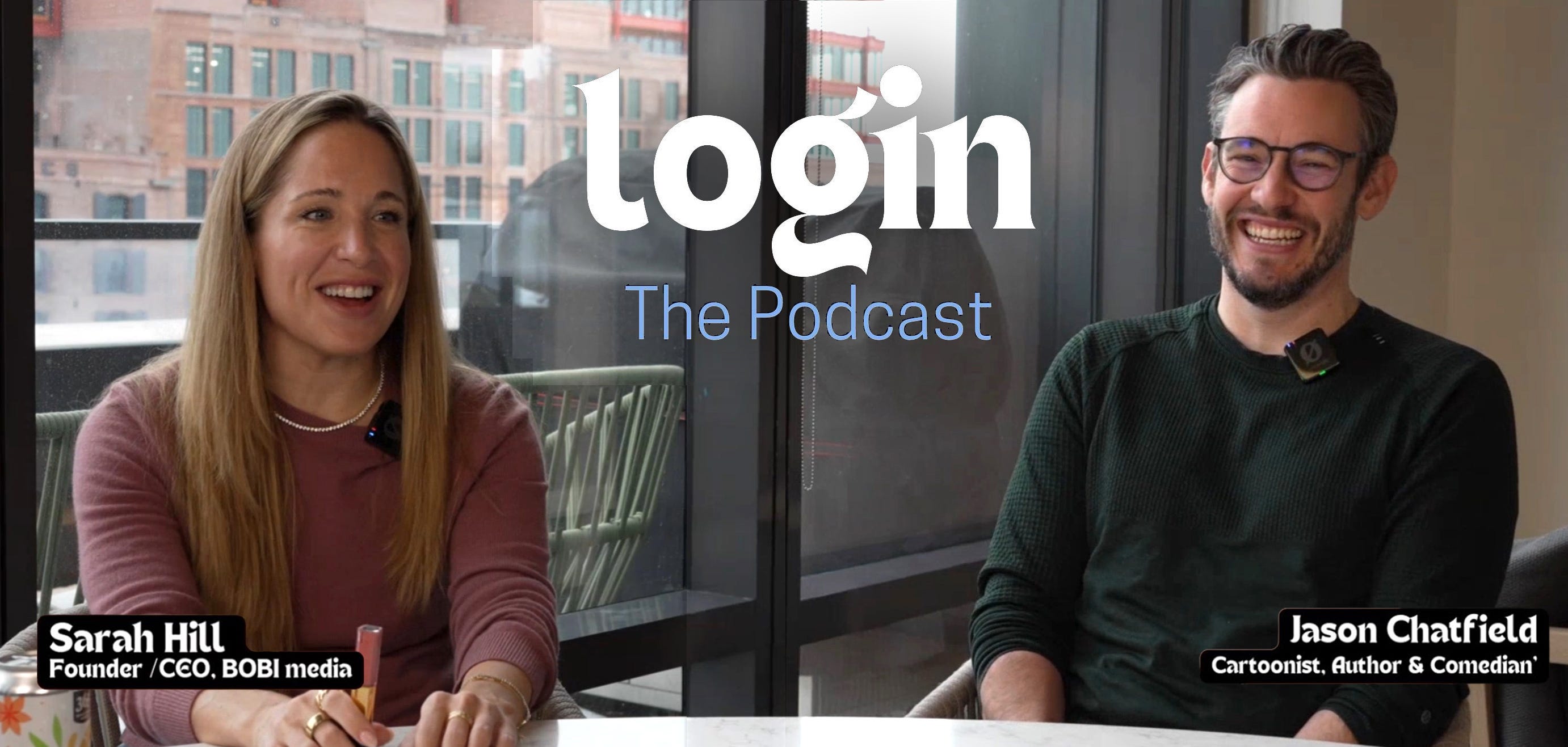
A recap of my chat with Sarah about the beautiful, masochistic reality of making a living as an artist on The Login Podcast.
Sarah and I have known each other for a while now, navigating the murky, caffeine-stained waters of the New York creative ecosystem. She is one of those rare, brilliant people who actually listens when you talk, which is probably why her podcast has become so incredibly successful.
It was great to finally be on her show. We had a lot of fun, mostly because she allowed me to rant at length about the sheer insanity of doing this for a living.
From The Podcast:
Jason Chatfield is an award-winning cartoonist, author, and stand-up comedian based in New York City. For 16 years, he wrote and drew the 102-year-old internationally syndicated comic strip Ginger Meggs. His work has appeared in The New Yorker, Esquire, MAD Magazine, Variety, Wired, and more. He’s a former President of both the National Cartoonists Society and the Australian Cartoonists Association, writes the award-winning Substack New York Cartoons with over 20,000 weekly subscribers, and serves as the portrait illustrator for Sam Harris’s meditation app, Waking Up.
But what struck me most in this conversation wasn’t his résumé — which he will massively downplay by the way. It was his discipline and entrepreneurial drive that sets him apart.
Jason talks about treating creativity like a business. About working from a calendar instead of a to-do list. About how jokes evolve from overheard subway moments to stand-up bits to New Yorker cartoons to full book series. And about what it really means to build a creative life over decades, not days.
We talk about failure, imposter syndrome, about backing yourself anyway, and about why chasing algorithms is a losing game compared to serving the people already in the room.
He’s an absolute beast of a creative force.
If you’re interested in the arts not just as expression, but as a way of living, building, and sustaining a career, this episode is for you.
When people find out you’re a cartoonist, they tend to romanticise the job.
They picture you sitting in a sunlit loft, wearing a beret, gracefully waving a dip pen while an adorable French bulldog sleeps at your feet. (Okay, the dog part is true. The rest is pure bullshit.)
The reality is that surviving as a creative requires you to be ruthlessly pragmatic. During the episode, Sarah asked me how I actually get anything done between drawing for magazines, doing stand-up, making books, taking illustration commissions, writing this Substack, and trying not to lose my mind.
“I completely abandoned the to-do list,” I told her. “To-do lists are just guilt trips on a piece of paper. If you want to survive, you have to embrace a business mindset for your artistic pursuits. You have to use a calendar for time blocking. If it’s not on the visual grid, it doesn’t exist. It is the only way to manage the chaos of diverse creative projects and commitments.”

If you enjoy my work and would like to support, please take out a premium subscription (just $1 per week)
I didn’t learn this in art school (because I didn’t go). I learned it from my mother. “My mum built a successful lighting consultancy business out of sheer necessity,” I explained on the show. “I credit her entrepreneurial spirit with my own work ethic. She taught me early on the importance of treating my art as a serious business, not just a hobby that occasionally pays for beer.”
Initially, I thought I was going to be a hard-hitting political cartoonist, taking down the establishment one crosshatched drawing at a time. But instead, I took over a syndicated comic strip. “That syndicated strip became my primary job for 16 years,” I told Sarah. “It was a grind, but it taught me discipline. And then, 11 years ago, I packed up and moved to New York City.”
Related Reading:

Moving to New York is like putting your career in a centrifuge. It spins you around, makes you nauseous, and separates the weak from the strong. But as I said on the pod, “The move expanded my opportunities a lot. It demonstrates the sheer value this city has for anyone with enough drive (and a high enough tolerance for subway rats and the smell of hot Chinatown garbage).”
Of course, living in New York and staring at a blank page every day is a recipe for catastrophic imposter syndrome. “You have to cultivate self-trust,” I said, with a heavy gulp. “You have to recognise that enjoying the creative process itself is what defines success, not the external metrics or the algorithm. I started seeking out inspiration differently. I take my AirPods out when I’m walking around the city and actively observe my surroundings. I consciously filter experiences and capture the ideas as they happen.”
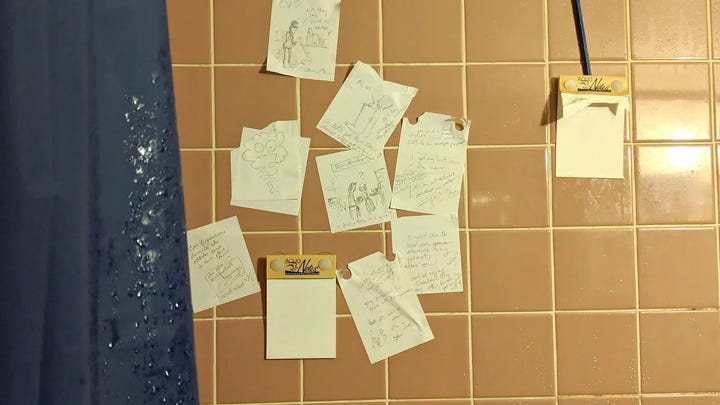
And because the universe has a cruel sense of humour, those ideas never happen when I am sitting obediently at my desk. “I literally keep waterproof pads in the shower,” I confessed... “Because that is where the real insights happen. It perfectly reflects the deeply unpredictable nature of creative thought.” (Anyone familiar with my ritual of ScotchBath Sunday won’t be surprised by this.)
But waterproof paper can’t protect you from everything. The conversation took a slightly darker turn when we talked about the nature of failure. I don’t mean small failures, like a new bit bombing at an open mic. I mean spectacular, soul-crushing failure…
