10 September 2026
TriBeCa, New York
Last night I put on a shirt I’d ironed 3 times, which is 3 more times than I’ve ironed anything since the divorce, and walked a red carpet in Lower Manhattan. Somehow, I’m in a film.
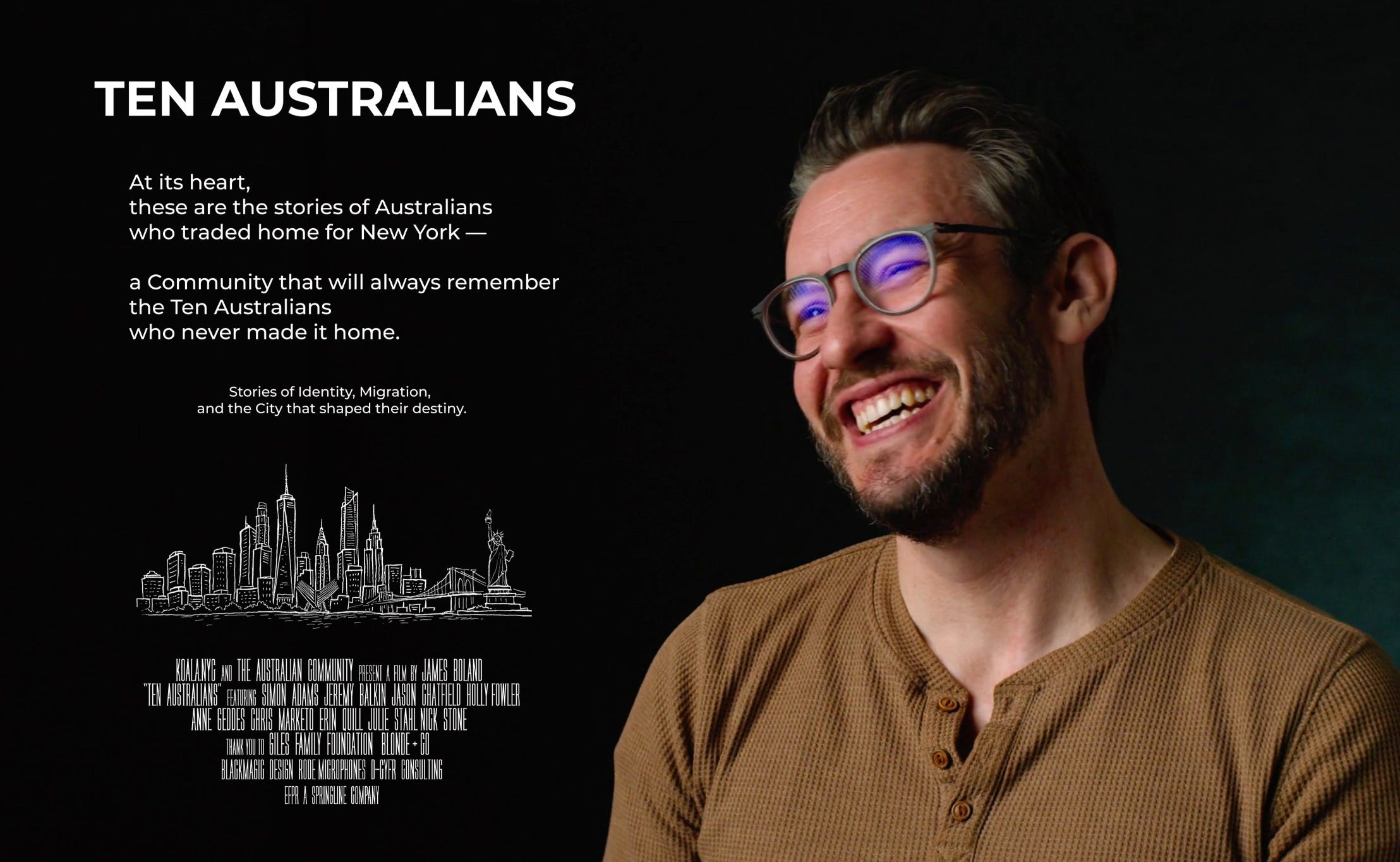
Not a big part, let’s be clear. But last night Ten Australians premiered in New York: a documentary by old mate James Boland, who runs the Australian Community here, and who I mostly see once a year at the Anzac Day dawn service, standing in the dark beside the New Zealanders and the Turkish officers who come to remember Gallipoli together. Still the most quietly awesome thing I’ve witnessed in this city.
The film is full of Australians who really bloody did something with their time in New York.
It’s full of high-achieving Aussies. (full bios here:1 ) Nick Stone, who decided New York needed a proper flat white and built Bluestone Lane out of the craving while he was still working at ANZ. Anne Geddes, who photographed every baby of the 90s asleep in a flowerpot (inspired by a cartoonist, btw!). Erin Quill, of the original Broadway cast of Avenue Q, and Simon Adams, who spent a decade advising the UN on how to stop crimes against humanity… Oh, and me: a grown man who draws funny pictures for The New Yorker and tells silly jokes on stage. I sat there in the dark, feeling like the free plastic toy in a cereal box of accomplished people, and started on martini number one.
But the title isn’t actually about the 10 of us on screen. It’s about 10 Australians who never got to be on screen at all: the 10 murdered on 9/11, among the nearly 3,000 killed in New York, at the Pentagon, and in a field in Pennsylvania. I bang on about them every September in Ginger Meggs (below), and James has dedicated his whole film to them.
James made this film with honesty, restraint and enormous delicacy. It does not flinch. There’s no music under the interviews, not much B-Roll to speak of, but it holds your attention the whole time. The 120-odd minutes feel like 30.
Friday marks 25 years since 9/11. I was 17, in the middle of my final exams, when the second plane hit the tower, and I heard my mum say ‘fuck’ for the first time in my life. I had no idea what the World Trade Centre was. I know now. I walk past where it stood most weeks.
Julie Stahl knew immediately. In the film, she remembers watching from her rooftop, which had a clear line to the towers, while the early reports called it a Cessna, and her friend from Sydney, who’d seen the plane, saying: “That was not a Cessna.” She remembers people waving tablecloths from the top floors. And she remembers what came next, which the anniversary coverage always skims: “Every New Yorker was there to help their fellow New Yorkers.” The volunteer line on the West Side Highway was so long that nobody had any hope of reaching the front of it. Sit with that image for a second. The worst morning in the city’s history, and the queue was to help.
That, for my money, is what makes New Yorkers New Yorkers, and it’s the thing I say in the film: “It was the worst thing that ever happened here. And yet, here we are, still standing, still moving forward.” 9/11 didn’t just wound New York; it calibrated it. Sandy? Bring it on. Blizzards, COVID, a rat dragging your dinner past you on the platform? Strap in. Resilience here is infectious. You catch it from strangers.
The other theme snuck up on me somewhere around martini number 2:
Distance.
Everyone in this film lives about as far from the people who love them most as geometry allows. I say in the film that if you drilled a hole through the earth from my apartment, you’d surface in the Indian Ocean, just west of where I grew up. Chris Marketo’s dad used to answer his calls home with, “I used to have a son called Chris, but he had an Australian accent.” Which is funny, until Chris tells you his mum cried on every one of those calls, right up until she was gone, and that he still does the terrible arithmetic of whether staying might have bought her more time.
Erin Quill rang a Cairns hospital 3 times to say goodbye to her grandmother. The third time, they told her: “She’s gone.” Erin calls all of this “a tax on your heart,”.
Other Aussie friends abroad and I call it The Expat Tax. It extracts a lot.
I talked about it in the film, and it was the hardest thing to do, but I’m glad I did. A lot of people came up to me afterwards to tell me I was speaking their exact thoughts aloud. It’s a difficult thing to explain to people who live where they were born and raised.
This is the film’s quiet trick, and the reason it belongs to this week: leaving and loss kind of rhyme…
New Yorkers learned everything about sudden distance 25 years ago. Expat Australians choose a smaller, slower version of it every time we say goodbye at an airport gate, not knowing which goodbye will be the last. James pointed out in the Q&A that we never even call ourselves immigrants; always expats (ie., there are Irish Americans, Chinese Americans, Italian Americans, etc., but no ‘Australian Americans’) because every one of us privately believes we’re going home eventually. We’re not. We’re just people who love 2 places at once, which guarantees we’re always missing one of them.
Afterwards, we all walked to Old Mates on John Street, where the beer was cold, and the accents sounded like home.
So here’s the one thing I’ll ask. James made this film in roughly 1,000 hours of his own life for under $10,000, which in documentary terms is a magic trick, and he’s now raising about $15,000 to $18,000 to carry it through festivals and beyond. Doc NYC decides on 15 September.
Please support this film. Watch the trailer below, and on Friday, when the bells toll downtown and the names are read aloud, remember that 10 of them are ours.
‘til next time!
Your pal,

Nick Stone was drafted into the AFL straight out of school in 1999 and played 6 seasons of professional footy for Collingwood, Hawthorn and St Kilda before trading his boots for corporate finance with ANZ and UBS. Then, in 2013, after concluding that New York could not produce a decent flat white to save its life, he opened Bluestone Lane, which now runs more than 75 cafes across the United States. More recently, he co-founded Old Mates Pub, which is where you’ll find most of us on grand final day.
Anne Geddes If you existed in the 90s, you know Anne’s work. The Queensland-born, New York-based photographer built an empire on those elaborate, iconic portraits of babies asleep in flowerpots and cabbage leaves, and was inducted into the International Photography Hall of Fame in 2017. She’s also a tireless advocate for children’s health: an ambassador for March of Dimes, a global ambassador for meningococcal disease awareness, and a partner of the UN Foundation’s Every Woman Every Child initiative.
Jason Chatfield A cartoonist, stand-up comedian, and the past President of the National Cartoonists Society. Despite surviving the sheer absurdity of having an iconic Aussie comic strip cancelled by Rupert Murdoch and watching a publisher pulp 100,000 copies of his hardcover book in 2023, he is still happily drawing away.
Chris Marketo is a seasoned executive in market research and consumer behaviour. Chris has held senior leadership roles, including Executive Vice President at Curion and VP at MMR Research Worldwide, helping some of the world’s biggest brands understand the psychology behind what people actually buy.
Simon Adams Until January this year, Simon was President and CEO of the Centre for Victims of Torture, the world’s largest organisation treating survivors of torture and advocating for its end. Before that, he spent a decade as Executive Director of the Global Centre for the Responsibility to Protect, leading advocacy at the UN and with governments around the world to prevent genocide, war crimes and crimes against humanity. He has written 5 books on human rights and mass atrocities. For scale: he spent his career preventing the worst things humans do to each other. I draw a redheaded child for a living.
Erin Quill, a dual US and Australian citizen, Erin is an actress, singer and writer who was a member of the original Broadway cast of the Tony Award-winning Avenue Q. Offstage, she’s known for The Fairy Princess Diaries, the blog where she has spent more than a decade championing AAPI representation and calling out the entertainment industry’s diversity problem, usually with more wit than the industry deserves.
Jeremy Balkin served as Global Head of Innovation and Corporate Development for J.P. Morgan’s payments business, and before that as Head of Innovation at HSBC. He’s the author of Investing with Impact: Why Finance is a Force for Good, which won the Axiom Gold Medal in Business Ethics, and he founded the fintech startup TodayPay. He has spent a career arguing that banking can be a force for good, which may be the hardest case anyone in this film has had to argue.
Julie Stahl is the founder and CEO of Blonde + Co, the Manhattan-based, women-owned creative agency behind campaigns for some of the world’s biggest beauty brands. She grew up in Australia and recently launched BLONDE.cares, the agency’s philanthropic arm offering pro bono creative work to nonprofits. She also gives her time to PAWS NY, helping vulnerable New Yorkers keep the pets who keep them going.
Holly Fowler grew up in Violet Town, rural Victoria (a post office, a grocery shop, a train station and the pub), where her dad was the local publican and she gave herself her first job at a very early age: holding the door open for the truckies and tradies, and welcoming each of them to the hotel by name. She has since graduated from asking truck drivers for a dollar for lollies to asking investors for millions: she’s the founder and CEO of Wable, the social app inspired by Love on the Spectrum that helps neurodivergent people build friendships, relationships and community. Launched in 2024, it now connects thousands of people across Australia, New Zealand, the UK and the US.
…and the bloke who made it all. James Boland is the founder and president of The Australian Community, the New York non-profit that has grown over 12 years into the largest organisation by Australian expat reach in North America; he’s the first call for Australians untangling US visas, tax and the general chaos of building a life here. Ten Australians, which he directed, is dedicated to the 10 Australians murdered on 9/11. It exists because he decided somebody should remember them properly.


Done and done. As Americans, we can never thank Australians and Canadians enough in my opinion.
Lest we forget.... :(