The Last Literary Lion of New York, Gay Talese
An interview with a master of his craft for The Metropolitan Review.
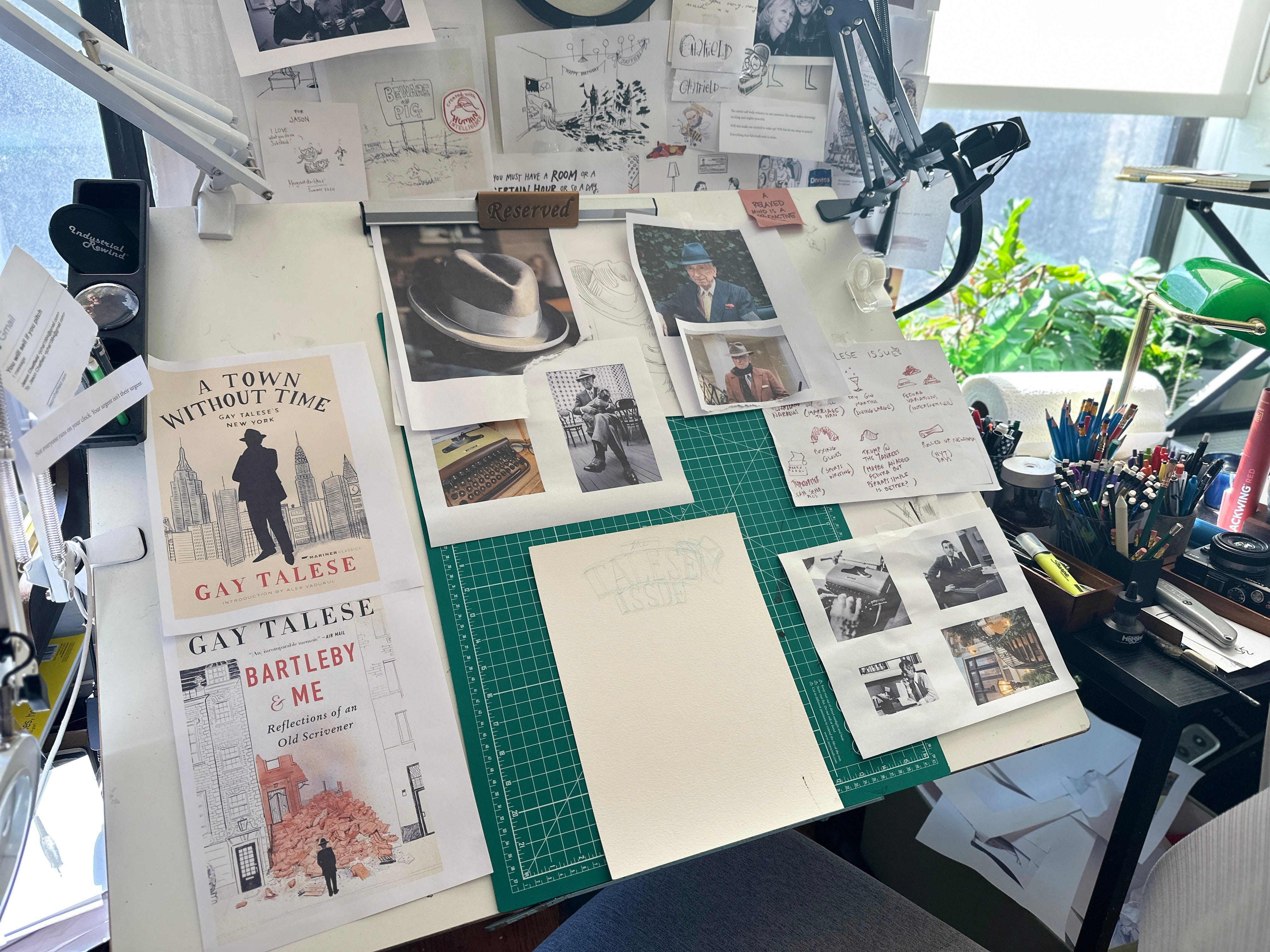
This is what my studio has looked like for the past week. I’ve been all-in on one single project. I did it all by hand, in dip pen and ink. I’m happy to say I can finally share the first part of it with you today.
I’m sharing with you today something I’ve been working on for a while, along with my friends and colleagues at
. This is the first in a series of works we’re sharing this week. Keep your eyes peeled for more.If you’re unsure of Talese and his work, you might recall my writing about Ed Sorel and his iconic cover illustration of Talese’s profile of Frank Sinatra for Esquire in 1966.
From Editor in Chief, :
A major project here from The Metropolitan Review, perhaps era-defining: I am very excited to announce the launch of Gay Talese week!
We’ve got, today, an extensive interview Lou Bahet and I conducted with the literary and journalism master. We spoke for several hours with Talese, who, at 93, took us through his remarkable career, from interviewing Joe DiMaggio and Frank Sinatra to documenting the rise of the largest suspension bridge, at the time, on earth. Talese is a marvel, the very last of his kind, and you’ve got to read all of this. Huge thanks to Alex Vadukul, Max Vadukul for the outstanding photos, and Cartoons Editor Jason Chatfield for his amazing illustrations.
Here is an excerpt of the introduction. You can read the entire piece here.
The Last Literary Lion of New York, Gay Talese
By & for
PHOTOGRAPHY BY MAX VADUKUL
INK BY JASON CHATFIELD
It is the rarest of gifts to have lived long enough to survey both a life and a century in its greatest breadth; even rarer still to be both an active participant and shaper of the currents, to have walked alongside the titans of the age and brought them, somehow, to fuller life. This is the shorthand for understanding Gay Talese, and it’s nearly correct: Frank Sinatra and Joe DiMaggio, in two immortalized magazine profiles, will be bound to this boy from Ocean City, New Jersey, forevermore. But Talese will be the first to tell you that “Frank Sinatra Has a Cold” is not his greatest work, nor the one he is most proud of. For a man who has dwelt, in one form or another, in a magnificent Manhattan townhouse since the 1950s — though it was not so splendid when he moved in as a mere twentysomething tenant, before it acquired its opulent grandeur over decades of his loving attention and escalating magazine fees — he has always been most at home with the men and women in the shadows, the ironworkers and sex workers and mobsters, not to mention the city’s scruffy alley cats.
Today, Talese is 93 and the very last of his kind: the dashing literary lion, the writer-celebrity, the pulsing center of a high culture that has, to our detriment, grown frailer. Among his contemporaries were Tom Wolfe, Nora Ephron, Joan Didion, Norman Mailer, Jimmy Breslin, and Pete Hamill; some he counted as close friends and others, as he’ll readily tell you, could irk him. To state that Talese is not an ordinary nonagenarian is like declaring that the New York Yankees, his favorite ballclub, are not a mere athletic franchise; we at The Metropolitan Review strain not to be so obvious. But sometimes, that’s where the truth lies.
On a warm afternoon in August, we had the pleasure of visiting Talese to conduct an interview that lasted nearly three hours and ranged over every topic conceivable: Sinatra, Trump, boxing, adultery, the writing life, the nudist life, the importance of dressing well. He will tell you, casually, about the time Styron occupied an upstairs bedroom to belt out what would become The Confessions of Nat Turner, or how Philip Roth’s first wife would come barging in at the strangest hours. He talks frankly about how deeply he loves his wife, Nan, a powerful book editor who is, at 91, still his wife despite a publicly turbulent marriage that was once on the brink of divorce.
His memory remains impeccable, and he will apologize profusely for forgetting whether a reporting trip of his occurred in ’98 or ’99. On the afternoon we met him, he wore a cream-colored three-piece suit that, he later pointed out, was one of the few not specifically tailored for him by a cousin in Italy. There are concessions to age that he openly resents: the elegant cane he uses from time to time and a sense of taste now mostly lost. He laments that he doesn’t get out nearly as much as he used to, though he still keeps “rock star hours,” up very late because of his nocturnal penchant for watching movies. He’s sure, at this point, he’s seen almost every film ever made. Writing is more of a chore because of a hand tremor, but up until 90, he says he had very few health problems.
Talese is strikingly undiminished, both regal and sprightly, not merely a bridge to the glittering midcentury but a full embodiment of its promise. Born into the maw of the Great Depression, he rose from newspaper copy boy to literary icon, reaping the rewards of a trade once flush with opportunity. What he remained above all was a reporter, bearing witness wherever he went, immersing himself for months or years at a time in a person’s life or culture. That, for him, was the prize of his trade: the hanging out, the cataloging, and, when possible, the elevating of the marginal and the vanquished. Decades ago, he would periodically wind up in the owner’s box at Yankee Stadium with a brash real estate developer named Donald Trump. Talese, who lives not far from Trump Tower, would sometimes find himself taking rides home with Trump, who was always willing to gab and court journalists. But Talese never wrote a profile of the future president. The already famous, the so-called winners, were not terribly interesting to him. He’d rather file dispatches on Floyd Patterson, felled twice by Sonny Liston, or those who never enjoyed the glory of a heavyweight title to begin with. This is apparent in his latest collection of reportage, A Town Without Time, which gathers up much of his New York work and excerpts from seminal writings on the Italian Mafia, the New York Times newsroom, and the ironworkers who built what was once the largest suspension bridge on earth. Wedged in too, of course, is a certain piece about a certain crooner who caught a cold.
Below is our conversation with Talese, condensed and edited lightly for clarity. We are deeply indebted to Max Vadukul for his never-before-published black-and-white portraits and to
, The Metropolitan Review’s Cartoon Editor, for his wondrous Talesian illustrations. With warm special thanks to .—The Editors


