The Machines Are Eating My Sketchbook (and yours) But There's Something You Can Do About It.
A black box, a poison pill, and three people trying to hand us a crowbar...
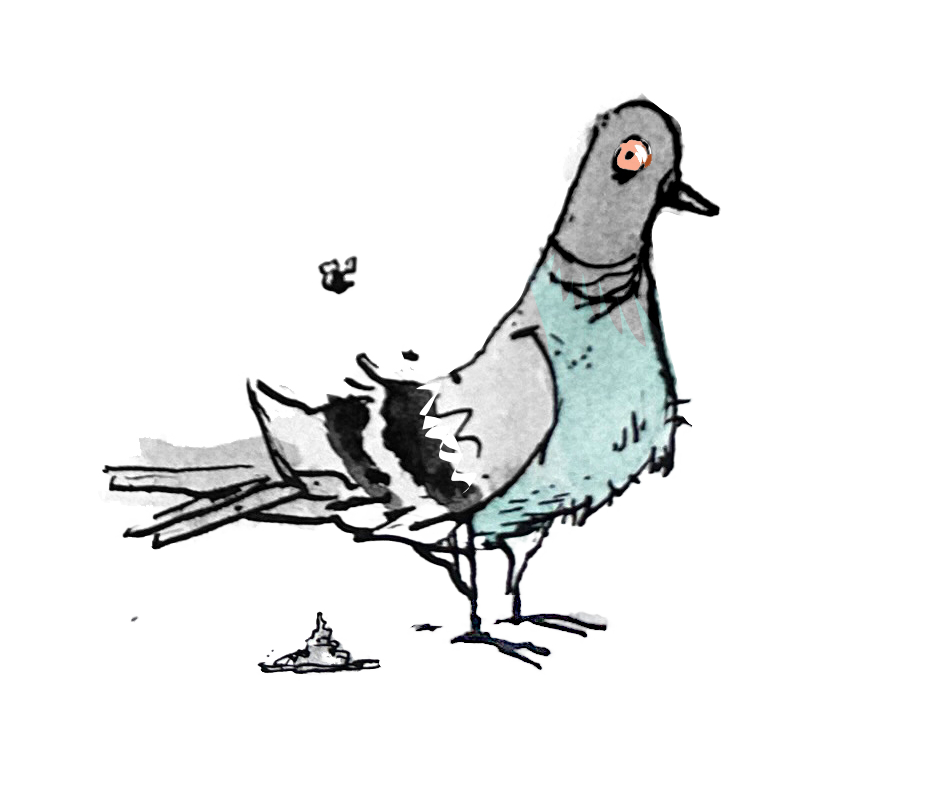
I have spent a not-insignificant portion of my life drawing things that nobody asked me to draw. Like this bird.
That is, more or less, the job. You sit in a studio in Hell’s Kitchen with a flex nib and a flatulent dog, and you make marks on paper, and occasionally somebody pays you for it. It is a precarious living at the best of times. The rent goes up. The fees go down. Morris requires an alarming volume of food for an animal who contributes nothing but methane and pure unadulterated joy to the world.
And now there is a new wrinkle, which is that somewhere out there, a machine may have already eaten everything I have ever made.
Not metaphorically. Actually eaten it. Scraped it off the internet, fed it into the great churning maw of a training dataset, and digested my decades of nib-scratching into a statistical smoothie that it can now regurgitate, on demand, for someone who types “cartoon in the style of” into a box and hits enter. No credit. No payment. No idea I ever existed.
The trouble is, you can’t see inside the machine. It’s a black box. You suspect your work is in there, the way you suspect there’s a mouse behind the fridge, but you can’t prove it, and you certainly can’t get it back.
This is the bit where I tell you I’m not a neutral observer.
A couple of months ago, I sat down with two of the people trying to do something about all this. Sally Herships, who is a properly award-winning audio journalist and runs the audio program at Columbia Journalism School, and Maty Bohacek, who is an AI scholar and the sort of person who understands the inside of the black box in a way that makes the rest of us feel like we’re colouring outside the lines. They, along with Pulitzer-winning political cartoonist Mark Fiore, have built a thing called Croquis.
If you enjoy my work and would like to support, please upgrade to become a paid subscriber (only $1 per week)
My actual contribution, such as it was, involved sitting with Sally and Maty and helping wrestle their messaging into something a cartoonist might actually read without their eyes sliding off the page. Because here is a thing the tech world doesn’t always grasp: creators are a fantastically hard bunch to reach. We are suspicious of jargon. We are allergic to being sold to. Our Bullshit-Detectors are off-the-charts. We have all, at some point, been burned by a platform that promised to be on our side and then quietly changed its terms of service at two in the morning.
So I sat in on the wordsmithing. The one-sheet they’ve put out - the thing that explains the whole project - has my fingerprints on it, in the sense that I kept saying “no cartoonist will read that sentence” until the sentences got better. It is, I think, the most useful thing I have done with a pen all year that did not involve drawing a dog. You can read it below.
Ok, what is this thing and what does it do?
Here is what Croquis actually does, in plain terms: It pries the black box open. It scans AI models to tell you whether your work has been scraped without your permission -either by searching the giant piles of training data for your name and your art, or by interrogating the models themselves to see what they’ve quietly memorised. A new tool designed by researchers to help artists figure out where their work has gone is, frankly, the first piece of leverage most of us have ever had. You can’t demand compensation for a theft you can’t prove. Croquis is the proof.
And it’s coming from the right place. Croquis was created by Mark Fiore and Sally Herships with help from an AI scholar at Stanford, funded by grants from the Herb Block Foundation and the Brown Institute, which is to say: not by anyone who stands to profit from selling your data back to you.
Now, the proving is one half of the fight. The other half is stopping the theft before it happens, and this is where the talk they’re giving comes in.
Watch the Walkthrough, Live
On 16 June at 7pm ET, Mark, Sally and Maty are running a free virtual webinar through the National Cartoonists Society called Protecting Your Art in the Age of AI. It’s the practical companion to all of this. They’ll walk through how to tell whether your work has been scraped, and then how to fight back using a couple of tools that sound made up but are gloriously real.
The first is Nightshade. Developed by a team at the University of Chicago, it messes up training data in ways that damage image-generating AI models - dogs become cats, cars become cows. It subtly alters an image at the pixel level so that AI programs see something totally different from what’s actually there. The lead researcher, Ben Zhao, compared it to putting hot sauce in your lunch so it doesn’t get stolen from the office fridge. Which is, I think, the single best description of a piece of security software ever committed to the record.
The second is C2PA, or Content Credentials, which works the opposite way round. It’s an open standard that attaches cryptographically signed, tamper-evident provenance to a piece of media - like a digital nutrition label, showing who made it, how, and what changed. It won’t poison anything. It won’t stop a determined thief. It demonstrates that a signer made certain claims, not that those claims are accurate, and most platforms strip the data out anyway. But it’s a start - a way of saying this is mine, and here is the receipt.
Nightshade is the hot sauce. C2PA is the label on the lunchbox. Neither one alone saves your sandwich, but together they’re a great deal better than the nothing most of us are currently working with.
The webinar agenda runs through the whole landscape: what AI theft is and why it matters, how to know if you’ve been scraped, how to prevent it, and what comes next. (Yes, they’ll also cover the new French Darcos AI Bill from earlier this month.) They’ll demo the new tools they’re building - the ones meant to hand creators a bit of agency back in a fight that has, so far, been spectacularly lopsided.
You might think AI is a mysterious black box beyond your control.
It’s not. That’s the whole point. And for once, the people telling you so aren’t trying to sell you anything.
Register for the webinar here: Protecting Your Art in the Age of AI
And if you want to find out whether the machines have been chewing on your sketchbook, you can join the Croquis waiting list - the one-sheet I helped (gently, insistently) wrestle into plain English lives at SFAI.agency.
‘til next time!
Your pal,
PS. Look, if this actually did something for your brain (or at least distracted you from the creeping dread of your own inbox for six minutes), please consider restacking this and sharing it with your people. It’s the only way the word spreads.


