Last September, a woman I’d never met sat me down and extracted confessions I’d never said out loud.
That I once needed my mum’s boyfriend’s cousin’s wife to smuggle a note to a cartoonist I was too frightened to email directly. That I pitched The New Yorker every week for 6 years before they took a single cartoon. That the best career advice I ever got arrived as a 5-page email from a Pulitzer winner I’d written an email to from Perth, fully expecting silence…
Somewhere around the part where I described seeing my first cartoon in print, she typed “Why am I crying?”
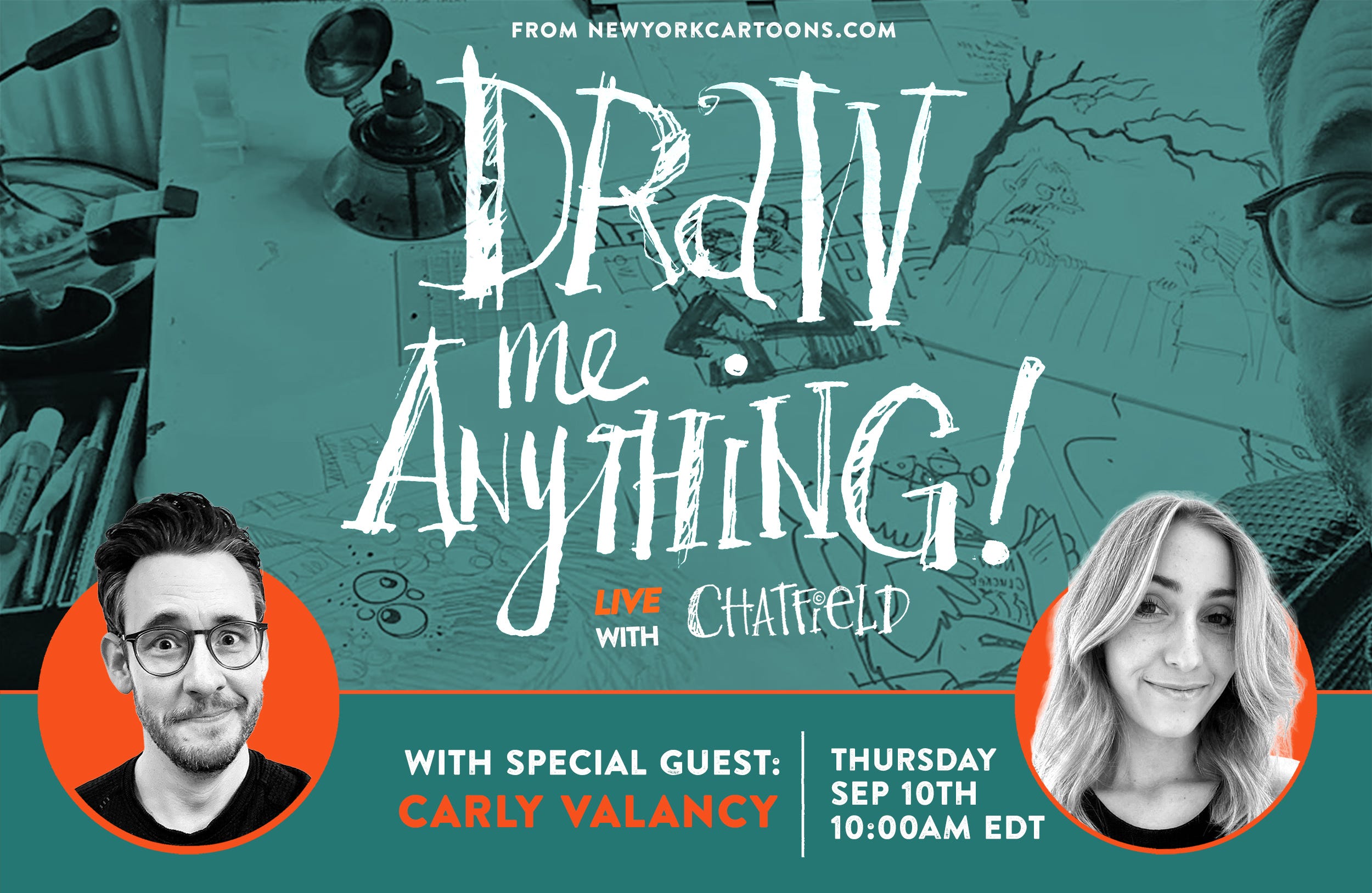
That woman was Carly Valancy. The interview ran on her Substack under the title “People get things because they ask,” which is the sort of sentence that seems obvious right up until you actually try it. This Thursday, the tables turn. She’s my guest on Draw Me Anything.
Who is Carly Valancy, you ask?
Carly is what happens when a Broadway performer takes a hard left into tech startups and comes out the other side with a philosophy. At 30, she reached out to 100 strangers in 100 days; it rearranged her life so thoroughly that CNBC wrote it up. Now she runs Reach Out Party, an 8-week mastermind where ambitious creatives finally send the emails they’ve been drafting in their heads for years. She hosts Anti-Networking events, co-runs a growth consultancy, and writes a good omen, a Substack read by 5,000+ people about how everything good -the job, the marriage, the big break- traces back to 1 person being brave enough to ping another.
Here’s the bit I love most: When Carly was 9, she wanted to be a cartoonist!
Her camp counsellor taught the cartooning class, and his dream was to be published in The New Yorker. She didn’t become a cartoonist. She became something arguably more useful: the person who gets everyone else to ask. But somewhere in there is still a 9-year-old who flips through the paper wondering who drew the cartoons. Which, I suspect, is how she found me.
I’m doing her Reach Out Party this year. Yes. A 40-something Australian who considers asking for a glass of tap water an imposition is now formally enrolled in an American asking academy. In Australia, requesting things sits somewhere between poor form and light treason; Carly has spent 7 years proving it’s the single highest-leverage thing you can do in a day. One of us is wrong, and I’m paying her to find out which.
On Thursday at 10, we’ll get into:
What a professional asker can teach a man who apologises to furniture
Why “networking” is a filthy word, and what she does instead
The 100-strangers-in-100-days experiment: what worked, what was mortifying
How to write a reach-out that doesn’t read like a LinkedIn ransom note
What thousands of scary drafts have taught her about what people actually want
When: This Thursday @ 10am EDT (4pm in Spain, where Carly will be enjoying considerably better weather and food than the rest of us)
Where: Live, right here.
Come with a question. If her whole thesis holds, you’ll get something just because you asked.
‘til next time!
Your pal,
PS: If you know someone who’s been drafting the same scary email since 2019, restack this and send it to them. Consider it your reach-out for the day.


Judicial Sovereignty versus Popular Sovereignty
Historians I have reviewed and studied agree that our Founding Fathers wanted our country governed by popular sovereignty. Above all, they sought to safeguard against rule by a despotic king or a parliament. They established a three-tier government to ensure that citizens, not anyone else, ruled it.
But since the 1800s, we have been governed by judicial sovereignty rather than by popular sovereignty. Popular sovereignty is the political principle that the authority of a state and its government is created and sustained by the consent of its people, who are the ultimate source of all political power. Judicial sovereignty is the principle that courts operate independently of the legislative and executive branches and hold the ultimate authority to interpret laws and review government actions for constitutional compliance.
With all their precautions in place, we have a country where the Supreme Court functions as a judicial sovereign, and the money Mongols rule us.
How did this happen?
How did we go from a country designed to be governed by popular sovereignty to one controlled by judicial sovereignty and ruled by oligarchs?
I reviewed the Supreme Court's history as best I could, hoping it might tell me something. I know the Court has two opposing philosophies about how it should function: originalism and living constitutionalism. Still, I believe none of these differences would have led us to our present state: a country with a dictator in the White House.
William J. Watkins, Jr., writes in his book “Judicial Monarchs” that Americans have been taught that the Framers designed the Court as the ultimate arbiter of constitutional issues. The Supreme Court has held that the federal judiciary is supreme in interpreting the Constitution. Watkins asks whether this judicial sovereignty aligns with the first principles of this new government, and he answers by tracing our English roots. Remember that the first English settlers left a land where King James and the Church of England emphasized that the king ruled by divine right and served as God's messenger. At the time, many believed a ruler was an absolute sovereign who recognized nothing greater than himself. After the Glorious Revolution in 1688, England's Parliament could make or undo laws.
Americans rejected the notion that a legislature held sovereign power or that God appointed the king. Instead, they emphasized popular sovereignty and used conventions to ratify written constitutions in which legislatures, governors, and judges served the people and exercised delegated power. Massachusetts was the first state to embody popular sovereignty in its constitution. The people wanted a new government framework that guaranteed and protected rights and secured the consent of the governed. That state created the “Massachusetts Agreement of the People,” part of the Massachusetts Constitution of 1780, and established the principle that a government must derive its power from the explicit consent of the people.
So where did we go wrong, and how did it happen?
Our founding fathers wanted a country ruled by the people, and the states did too. Yet today we are ruled by oligarchs and Supreme Court judges. Watkins states that our present Supreme Court resembles a divinely anointed monarch of the 1600s or the omnipotent British Parliament of the 1700s. Popular sovereignty - the legacy of the American Revolution - has been forgotten. At its inception, however, America took a different, braver course and accepted popular sovereignty. The people, not the legislatures or other artificial bodies, held ultimate power. Authority could be delegated to agents such as governors, representatives, or judges, but true sovereignty rested with the people.
What became obvious to me was that at the 1779 convention, the Federalists and Anti-Federalists disagreed sharply. Federalists wanted more power invested in the new government, while Anti-Federalists wanted the document to acknowledge the importance of the states and the people of those states; they wanted popular sovereignty. In my view, this difference was fundamental to the divide that billionaires used to control our government and increase their wealth.
If the government were in control and could bribe representatives, it could use this enormous government to benefit itself. In Prospect 2025, the Heritage Foundation spelled out its objectives: a smaller, weaker centralized federal government and a more powerful president. These are the conditions for a takeover of our government.
Watkins argues that to remedy this, Americans must remember that, to the founding generation, judicial independence never meant independence from the people. State and federal judges are not high priests of the constitutional order. Like governors, senators, and representatives, judges are mere agents of the people. When judges begin making public policy decisions, they rebel against their masters and usurp power.
Another change driving this shift was that, beginning in the late 1800s, the Court gradually asserted the power to judge the reasonableness of laws passed by national and state legislatures. Writing in 1893, Harvard Law Professor James B. Thayer warned the courts against dabbling in judicial supremacy. At that juncture in American history, the Supreme Court had just begun to hint that it was open to using the Fifth and Fourteenth Amendments' due process clauses to assess the reasonableness of legislation. This threat of judicial sovereignty or judicial activism is not new. Judicial activism is a judicial philosophy that holds that courts can and should go beyond the applicable law to consider the broader societal implications of their decisions. It is sometimes used as an antonym of judicial restraint. The term usually implies that a judge rules based on personal views rather than precedent. Even before this phrase was coined, the general concept already existed. For example, Thomas Jefferson dubbed the judiciary a "despotic branch."
Our founding fathers had wonderful intentions, but they had no idea where we would be 250 years later. We must address their shortcomings by taking action to address what is happening in our country. Some things can be done, but it will require serious, difficult changes to restore our government and protect our way of life.
Can't wait!
