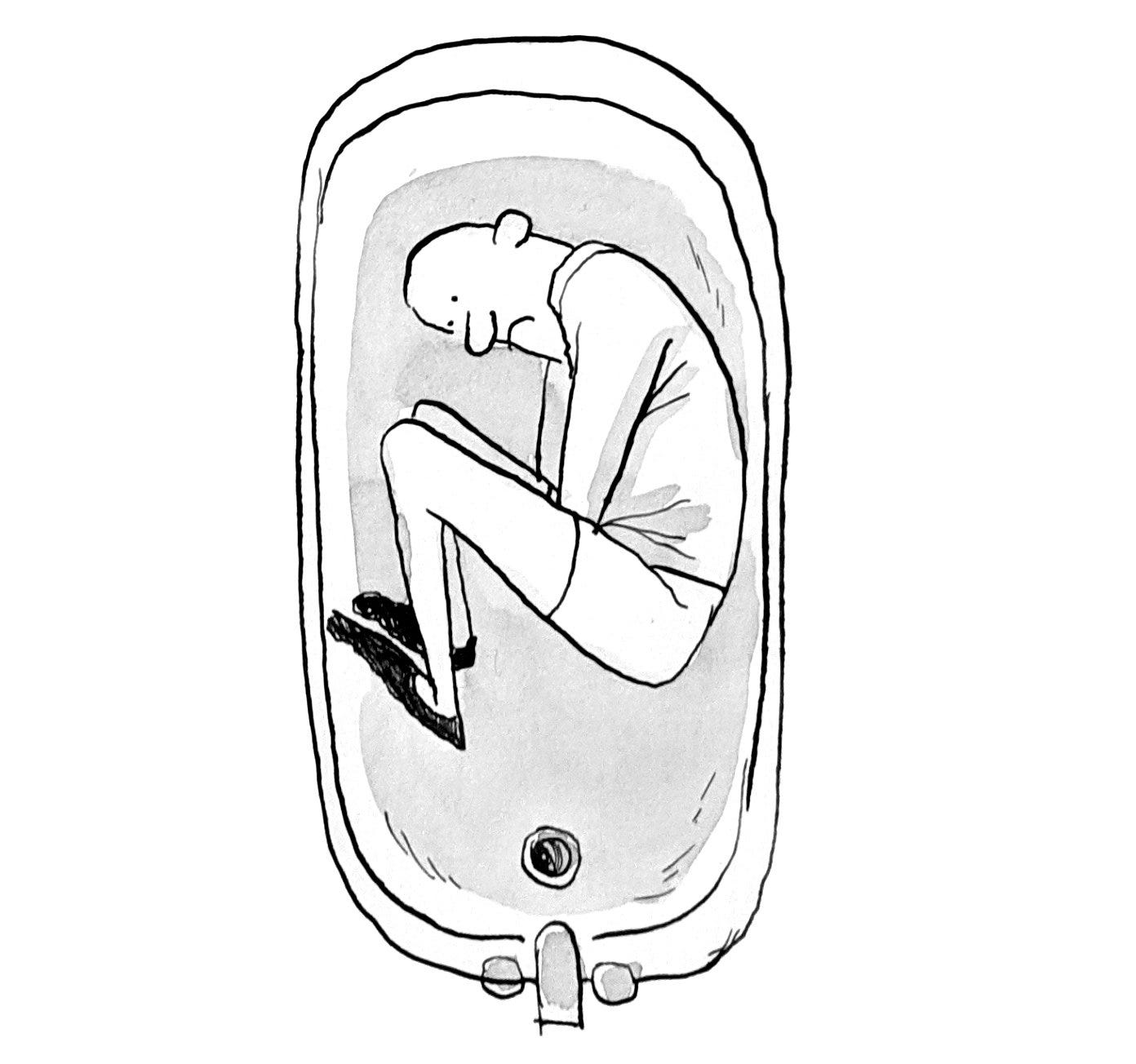
You're Not Going Crazy- Things are Really, Really Bad for Working Artists (and the trend isn't pretty)
Drawn and Quartered: Why things really are tough for illustrators right now (and why I’m still drawing anyway)
“2025 is the year the industry changed, and it will never go back.”
If you’ve been wondering whether illustration feels harder than it used to, congratulations… It’s not in your head. The market really is collapsing like a poorly stretched canvas. The gigs are smaller, the rates are lower, and somewhere in Silicon Valley, a guy named Chad just typed “in the style of Jason Chatfield” into Midjourney for free.
I read this Creative Boom article with gritted teeth this week -the one confirming what most of us already know: illustrators are working twice as hard for half as much. Clients who used to pay decent money for a handmade piece of art now offer “exposure.” Corporate clients want a “quick sketch” that somehow embodies their entire brand strategy, due tomorrow. Art directors are now “Content Strategists,” and deadlines are measured in minutes, not days.
Across the illustrator community, we’re seeing a consistent pattern. Established professionals with years of successful freelancing behind them are suddenly finding their inboxes empty, their follow-ups ignored, and their income streams drying up to a trickle.
Neil Stevens, who’s spent over 12 years building his illustration career, puts it bluntly. “I’ve officially dusted off the CV and am looking for full-time, paid work again. I’ve never known anything so quiet as this year. There was a time I would be earning £80-90k plus. This year I’ll barely make £10k. It’s fallen off a cliff.”
For those who’ve built a client base via social media, platform changes pose a further challenge. Illustrator and designer Bulma, aka Vilmante Juozaityte-Suchocke, who started freelancing in 2019, explains: “My Instagram DMs used to be full of inquiries, but this year has been completely quiet. Everything is moving towards reels, and algorithms prioritise video content. So it’s much harder to rank well and be visible to new audiences with still images.”
Illustrator and designer Holden Mesk, who started in 2017, shares a similar experience. “I used to have a steady flow of clients all the time,” he says. “My DMs on Instagram would always have someone inquiring about album covers, merch designs, beer labels, etc. But this past year, it’s been a ghost town.”
The notion that illustration as a discipline will fight back is a beautiful dream, but that’s all it is, a dream,” he believes. “2025 is the year the industry changed, and it will never go back.” Veteran illustrator Peter Grundy concurs. “There have always been downturn periods in the creative profession,” he recalls, “but these have usually been linked to economic recession. I fear this one may mark a sea change in creative attitudes globally.”
Read full article: No, you’re not imagining it: things are really tough for illustrators right now
When I started freelancing twenty-one years ago, there was at least the illusion of stability. You’d invoice a job and a few weeks later, a cheque would arrive like a small, papery miracle. Now? You send an invoice, and it vanishes into the digital void. You follow up politely. You send another. You start wondering whether you’re the world’s first invisible man. Other artists are telling me the same thing. It’s more than a little concerning.
New York Cartoons is a reader-supported publication. This is all I do now. Please become a free or paid subscriber for just $1/week.
And then there’s AI… the new uninvited intern who works for free and never sleeps. I’m not anti-technology; I love a good shortcut. But there’s something uniquely demoralising about watching a machine crank out soulless “masterpieces” in seconds while you’re still trying to fix the hand on panel three. You spend a lifetime learning to draw emotion, and suddenly a chatbot is vomiting “emotion” in 8K.
Here’s me talking about it back in late 2022, when nobody was really listening to me saying this was going to be an utter disaster for working artists. I got a lot of smirks and ‘Chicken Little’ comparisons, and I wish I were wrong. So does my accountant.
But here’s the thing: illustration is not just about image. It’s about interpretation.
It’s about that strange alchemy between artist and idea. The tiny human fingerprints on a thought. AI can imitate, but it can’t understand the sigh behind a line or the sadness in a gag about pigeons and rent prices.
I’ve been lucky, to a degree. I’m still working, still drawing, still able to afford printer ink (most weeks). But I’ve also had to adapt: I draw live, I write essays, I perform comedy, I teach. I treat illustration less like a job and more like a language- one I keep learning how to speak as the dictionary keeps changing.
So yes, things are tough. The industry’s shrinking, attention spans are collapsing, and artists are competing with robots. But I’m still here, pen in hand, caffeine (and sometimes beer) in system, trying to make people laugh -and, at a stretch, maybe think- with a few good lines.
Because, as hard as it gets, I’d rather draw for a living in a broken system than stop drawing altogether. At least this way, when the robots take over, they’ll have something decent to trace.
‘til next time,
Your pal,


You're onto something re: interpretation. I see a lot of AI-generated illustrations is in clickbait or other disposable venues (the stock image companies must be taking a beating); hard to weep about that. The art-directed AI content I see in feature pieces is created by a real person using AI tools, which is no small task. To generate something that connects with the soul takes significant creative effort, though at a tablet and a keyboard not an easel. So there's a new tier of artist developing comparable to the transition portrait painters faced with the advent of photography.
"Twice as hard for half as much" is a powerful phrase. As an artist (and, to be honest, as an employee in many different jobs) I have often felt that I am volunteering much more than I am paid for. Alas, that's capitalism isn't it? Someone capitalizing on your effort/talent. But isn't "Half as hard for twice as much" the promise being held out for AI?
