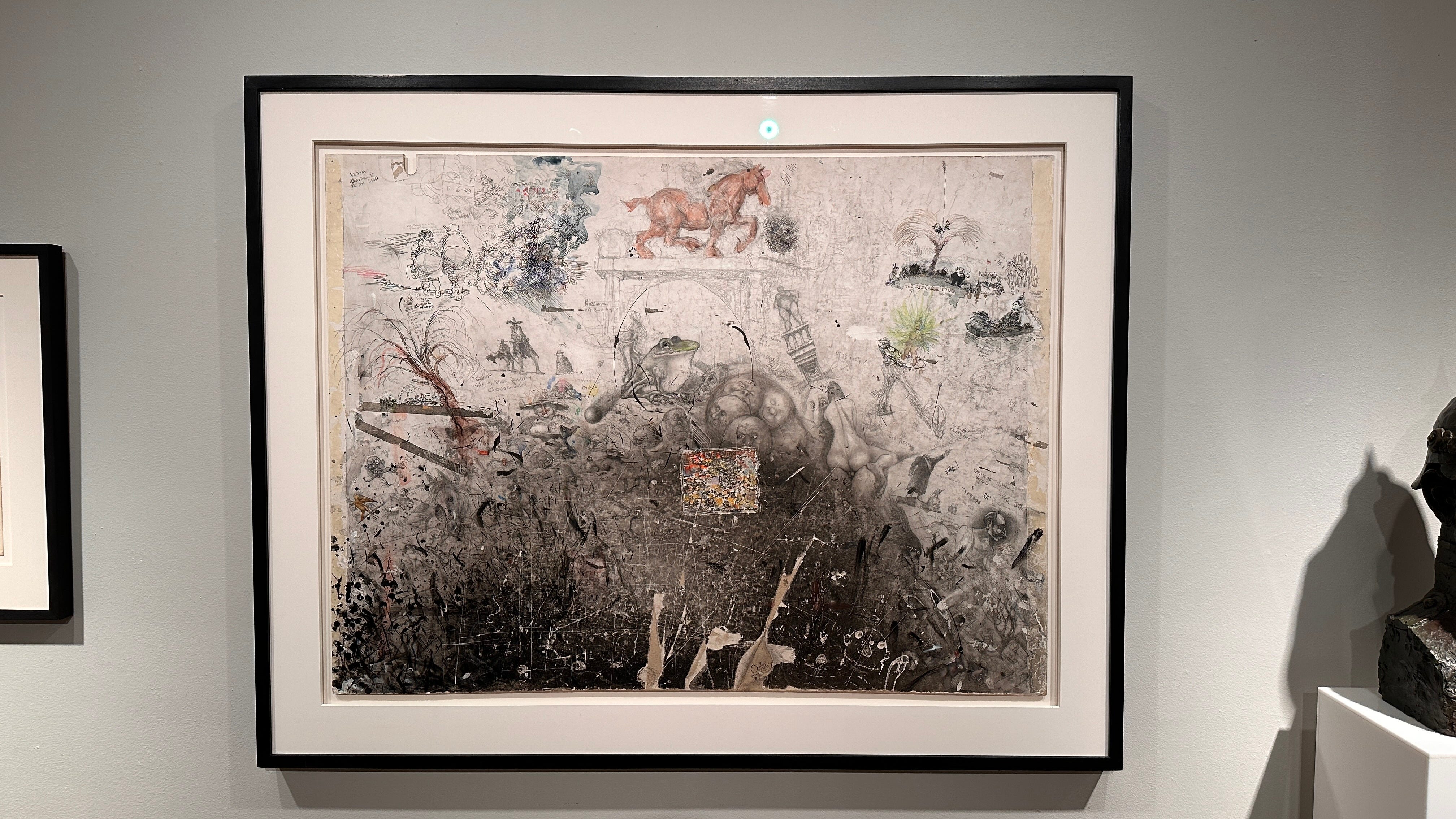
"The Man on the Trunk of the Tree."
Pat Oliphant, 1935-2026
Tuesday, July 14th 2026
New York, NY
There’s a photograph on my hard drive of a group of cartoonists crowded into a hotel room 20 years ago, all of us grinning like we’d won something.
We had, in a way. The Australian Cartoonists’ Association had flown Pat Oliphant and his wife Susan out as guests of honour for the Stanley Awards, which is our version of the Reubens, and a handful of us had been quietly ushered up by the President to meet him.
I didn’t notice until later, looking at the photo, that at the exact moment I pressed the shutter, the most decorated political cartoonist in the history of the form had calmly flipped the bird.
No announcement. No wink. Just a 74-year-old master craftsman deploying a middle finger with the same precision he’d aimed at every American president since Lyndon Johnson. It was the most Pat Oliphant thing imaginable: sneaky, perfectly timed, and funnier than anything else in the room.
Pat died on Sunday, aged 90. And I want to make a claim I’ve been bloviating about at dinner parties for years, usually to people with no way of checking: Pat Oliphant is the most influential Australian ever to emigrate to the United States.
I know. Rupert Murdoch also exists. But influence has a sign in front of it, positive or negative, and I’d rather not get sued in two hemispheres, so let’s move on.
From Adelaide to everywhere
The facts of the career, courtesy of the ACA’s tribute this week, read like something a Hollywood executive would reject as too tidy. Born in Adelaide in 1935. A cadetship in the art department of The Advertiser. Then, in 1964, a vacancy at The Denver Post, which he grabbed at the urging of a fellow Australian cartoonist named Paul Rigby.
Within a year of landing in America, the Los Angeles Times was syndicating him nationally. Within three, he’d won the Pulitzer. By 1980 he’d joined Universal Press Syndicate and become the most widely syndicated political cartoonist in America, running in more than 500 newspapers -enough leverage that no editor could tell him what to think, which suited him, because no editor ever successfully had.
Here’s my favourite measure of his influence, better than the Pulitzer, better than the seven NCS Editorial Cartoon Awards, better than the two Reubens or the Thomas Nast Prize: at one point Pat started using DuoShade board, a chemically treated paper that produced textured grey backgrounds. Nearly every political cartoonist in America immediately did the same. When he dropped it in the early 80s, the company’s sales collapsed.
That is influence. Not applause. Not likes. An entire industry buying the paper you buy, then abandoning it the moment you do, like starlings.
Perth, a drawing desk, and a stack of photocopies
When I was 17, at my very first drawing desk in Perth, I sat with a pile of Oliphant cartoons and tried to reverse-engineer them the way other teenage mechanics apprentices took apart car engines. How did he compose a panel? Where did he put the solid blacks? Why did that one patch of untouched white paper feel louder than everything around it?
I never fully cracked it. Nobody has. But the exercise taught me more than any art school could have, because an Oliphant cartoon was an ecosystem: remove one element and the whole thing collapsed. He knew exactly what to draw, and more importantly, he knew exactly what not to. He never cross-hatched to fill space. Everything on the page was there on purpose.
He was, and I will not be taking questions, the finest draftsman who ever worked in this game. Alongside names like Thomas Nast, he sits in the very small club of cartoonists who changed what the job was. Fittingly, in 1992 they gave him the prize named after Nast. If you weren’t trying to copy what Pat was doing, you weren’t serious about your job. Most of us were trying. None of us were succeeding.
“Pat Oliphant lives on the trunk of the tree. Remove him, and you don’t get a different tree. You get a stump.”
~ Nick Galifianakis
And there was the Perth connection. Paul Rigby, the same West Australian who’d talked Pat into taking the Denver job in 1964, wrote to Pat on my behalf in 2006, when I was 21, asking him to look after me if I made it to Washington DC. The timing never worked out. So when I finally shook Pat’s hand in that Sydney hotel room three years later -the same trip on which he was inducted into the Australian Cartoonists’ Hall of Fame- it felt like a forty-year-old favour being quietly passed down a generation. They say ‘never meet your heroes’, but with cartoonists that always turns out to be absolute bullshit.

What the others have said (better than I ever could)
Ann Telnaes, the Pulitzer-winning cartoonist who resigned from the Washington Post rather than soften her pen, published a lovely tribute to Pat this week. She describes meeting him as a young cartoonist at a DC gallery signing in the early 90s, working up the courage to introduce herself, and having her fiancé mention that she was an editorial cartoonist too. Pat looked at her sternly and growled: “You do know it’s a dying art, don’t you?”
So much for encouraging the youth. (She also notes, correctly, that nobody in the profession came close to his drawing ability, and that Susan Conway -the Washington gallery owner who became his wife and made it her life’s work to see Pat properly credited- was the reason the world knew it. Susan died in December, just seven months before him. I hope wherever they are now has good paper.) Read Ann’s full piece above.
And in 2023, my friend Nick Galifianakis stood up at the Reuben Awards in front of the National Cartoonists Society and delivered the best summary of Pat’s importance I’ve ever heard. I had a small hand in helping Nick put the tribute together, which mostly involved staying out of his way. His argument went like this: he likes Taylor Swift, but if you removed her from the history of pop music, nothing downstream changes. Remove the Beatles, and everything after them changes. “Taylor Swift is a lovely limb on the musical tree of pop music. The Beatles are on the trunk of the tree.”
Pat Oliphant, Nick said, lives on the trunk of the tree. Remove him, and you don’t get a different tree. You get a stump.
He also said something that has rattled around my skull ever since: Pat “drew and wrote for an audience of exactly one person: himself.”
He wasn’t chasing likes. He wasn’t preaching to a choir. He hit everybody, all sides, all ideologies, and he hit hard, which is why the people who hated him read him even more religiously than the people who loved him. Watch Nick’s full speech above.
Pat formally retired in 2015, though the arrival of the Trump presidency briefly un-retired him and his little penguin in 2017; some subjects are simply too well-suited to the instrument. It was the shortest comeback tour in history and, pound for pound, one of the sharpest.
The blotting paper
The last time I was in a room built around Pat’s work was in 2023, at the Century Association in New York, where he and Susan had kindly invited me to a tribute exhibition of his sculptures, sketches and cartoons. Pat’s eyesight had failed, and he could no longer travel, so a gaggle of us -Jeff Danziger, Signe Wilkinson, the inimitable Edward Sorel, a table groaning with Pulitzers- recorded a video message to him instead, a room full of sharp-tongued professionals suddenly gone soft. We all scribbled a little note to be sent back to him. I sketched one of his busts along with his quippy penguin, and sheepishly slid it under my napkin before the giants could catch sight of it.
The gallery held bronzes that could have gone straight into a museum’s permanent collection, and caricatures so incisive they should have required a licence. But the piece that stopped me cold was none of those.
It was his blotting paper.
The big sheet on his drawing desk where he’d test a nib or drag a brush before committing a line to the actual cartoon. Decades of warm-up strokes, half-thoughts, tiny studies, noodlings. Nobody was ever meant to look at it, and it was one of the most extraordinary pieces of art in the building: the mind of a genius with the hand of a master, caught with its guard down. A da Vinci codex made entirely of throat-clearing.
I’ve thought about that sheet a lot since.
We spend our careers trying to make the finished thing look effortless, and here was proof that for Pat, even the effort was beautiful.
Nick closed his Reubens speech by telling the young cartoonists in the room to push their talent, be authentic, and make something beautiful, so as to honour “a time when giants roamed the earth.”
The last giant put his pen down on Sunday. He is survived by three children, two stepchildren, four grandchildren, two great-grandchildren, and every working political cartoonist on earth, whether they know it or not.
The rest of us go back to our drawing desks, look at our own scratch paper, and try to earn our keep.
Vale, Pat. Thanks for the finger.
‘til next time!
Your pal,


This is beautiful. What an astounding talent! Thank you for sharing the photos of the gallery---I love the bronzes. But you're right---Oliphant's blotting paper is just stunning. The world was a much better place because of him. Glad there are people like you trying to follow in his giant footsteps. Thank you, Mr. Oliphant, wherever you are.