


I was sitting at my drawing table this morning, staring at a very stubborn ink smudge on my fingernail (I think it might be paint? But it could be ink. I don’t know.) I’d just spent two hours wrestling with my pen nib, trying to draw a person falling butt-first into a toilet. My neck hurt, my coffee had gone cold, and my brain felt like day-old oatmeal.
In moments like that, the frictionless, sterile world of Artificial Intelligence can look awfully appealing. You could just type, “person falling butt-first into a toilet, cinematic lighting, 4k,” and an algorithm spits out a masterpiece in four seconds. No ink smudges. No carpal tunnel. No existential dread or anxiety attacks.
But then I opened the news*, and I felt a deep, warm wave of schadenfreude wash over me.
(*Let’s be honest. I opened Instagram and doomscrolled until I saw a news article.)
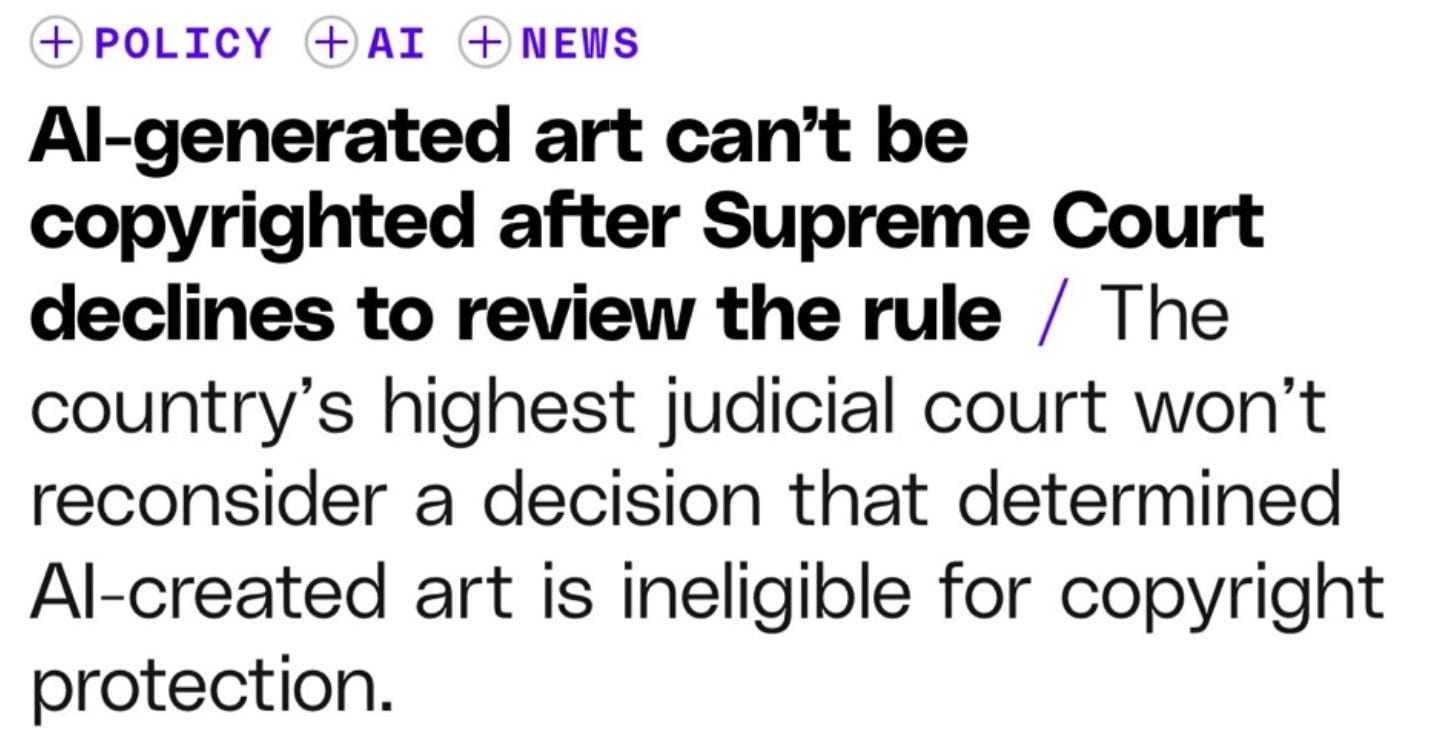
The Supreme Court of the United States just officially declined to review a petition regarding the copyright eligibility of AI-generated artwork.
By refusing to intervene, the country’s highest judicial court signalled an implicit consensus with lower courts, effectively cementing the rule that artificial intelligence cannot be legally recognised as an author.
In short, AI art cannot be copyrighted. Zero. Zilch. It belongs to the public.
To understand why this is so massive, we have to look at the bedrock of American copyright law. The U.S. Copyright Office has consistently maintained that human authorship is an absolute, non-negotiable prerequisite for intellectual property protection. They will literally refuse to register a claim if a human being with an ink-stained fingernail didn’t create the work.

If you enjoy my work and would like to support, please take out a premium subscription (just $1 per week)
This isn’t actually a new fight. It dates back to the late nineteenth century. I know this because I spent time researching this instead of finishing that picture of the person on the toilet. (I’ll get back to it, I promise.)
In 1884, the Supreme Court heard the landmark case of Burrow-Giles Lithographic Co. v. Sarony. Back then, sceptics of the newly invented camera argued that a photograph was just a mechanical reproduction of physical reality and lacked any creative intervention. But the Court ruled that photographs were copyrightable because the photographer made choices regarding lighting, posing, and costume, which constituted the necessary “original intellectual conceptions of the author”.
For the last year, tech bros have been arguing that typing a prompt into a large language model is the modern equivalent of clicking a camera shutter. The courts have firmly answered: No. No, it isn’t.
