Over Austin Kleon’s shoulder, the whole time we talked, Lynda Barry watched us.
Not the actual Lynda Barry; an original manuscript page from Cruddy, hanging on his studio wall next to an outtake from Making Comics. He calls them his Guardian Spirits, and the plan is to keep adding to them until he’s got a full pantheon of demigods looming over his desk.
I understand the impulse completely. I’ve got a drawing of Larry David in my studio that Luke Watson painted for me, and he glares at me every day with an expression that says, “Is that really the version you’re gonna go with? Aeeeeh, it’s prettaaay pretty good.”
This was Austin’s second time on Draw Me Anything, and I’d be lying if I said we covered the book in an orderly fashion. We started with 63 people in the chat and ended with 350, which means roughly 287 people wandered in midstream to find two middle-aged cartoonists arguing about whether Hook is secretly a midlife-crisis film.
It is. More on this later. It gets worse.
(Bangarang!)
Don’t Call It a Book Tour
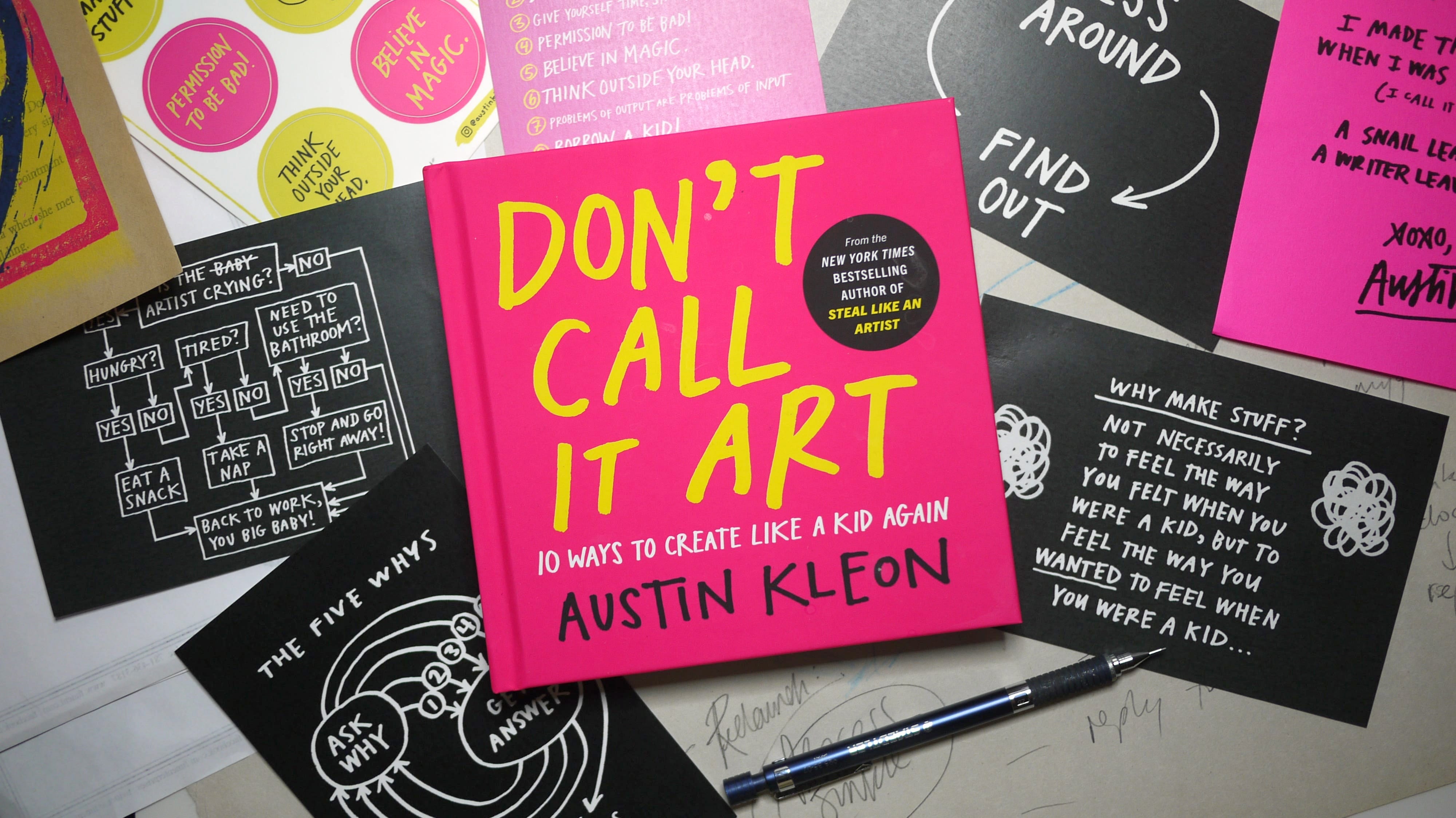
The new book is called Don’t Call It Art, and Austin, a man committed to the bit, named the promotional run for it the Don’t Call It a Book Tour. Previous books got 25-city tours. This one got three cities: Austin, Nashville and Cleveland, which he described as “kind of like a straight shot to Cleveland type tour.”

If you enjoy my work and would like to support, please upgrade to become a paid subscriber (only $1 per week)

He slept in five beds in six days. “This is a young person’s game,” he said, and every comedian who’s ever done the road nodded so hard the vertebrae in their necks audibly clicked. The week after a launch, he told me, all the things that keep you alive as a creative person, the sleep, the walks, the daily ritual, go straight out the window. The man who wrote the book on sustainable creative practice blew himself out promoting a book about sustainable creative practice. “I wish the books worked on me better,” he said, which might be the most honest thing anyone has ever said on this series.
Nobody Knows Anything, Confidently
We got into the publishing industry, which Austin summarised via William Golding’s old line that nobody knows anything: true of Hollywood, true of books. Nobody in publishing knows what sells books, he said, “but they’ll say something confidently to you about it.” Everyone’s chasing BookTok, which is lightning in a bottle, on purpose, which is not how lightning or bottles work.
The only thing that actually sells a book, he said, quoting Ann Patchett, is one person holding it up and saying I love this. Word of mouth. That’s it. That’s the whole machine.
And then he reached for Charles Portis, because of course he did. There’s a line in Gringos about two men who “had known the despair of selling things that people didn’t want,” and Austin pointed out that this is the entire creative life. Nobody is asking for another book. Nobody asked for another cartoon. Nobody wanted a live-action Moana. You make the thing anyway, and then you present it, over and over, like Marshawn Lynch running through a man’s chest. Austin apparently plays the Beast Mode clip to himself on a loop when the self-promotion shame creeps in. If you run through somebody’s face, over and over and over and over and over …. eventually they can’t take it any more. This is also, coincidentally, my approach to open mics.
The shame is real, though. You think: my audience must be so sick of hearing about this thing. Meanwhile, an actual paid subscriber to Austin’s newsletter walked up to him in Nashville and said If I’d known you were in town, I’d have brought all my friends. The man works across the street from the hotel. He pays money to be told these things. He did not know.
So no. Nobody is sick of hearing about your thing.
They have not heard about your thing.

The Taco Bell Theory of Art
My favourite framework of the day came from, and I want to be clear that I am quoting a bestselling author here, Taco Bell. Austin loves their “distinctiveness rule”: you can change the taste, or you can change the form, but never both at once. That’s how he thinks about his readers. Keep the familiar square format, but fill this book with his kids’ drawings and new textures, so it reads like an Austin Kleon book that was somehow drawn by his children. (This “RED” rule stands for relevance, ease, and distinctiveness.)
He’s unapologetic about thinking of his audience while he works, which felt almost transgressive to hear out loud. “My readers have given me everything,” he said. “This idea that I wouldn’t think about them when I was writing is just weird to me.” His books, he insists, aren’t pure art anyway; they’re the byproducts of him trying to make stuff. The Montel Jordan principle: this is how we do it. Not how you have to do it. This is how we do it.
Neither of us went to art school, which is probably why we both find kids so instructive. They don’t know the correct way to do anything, so they just let it rip.
Why the Book Exists at All
The title comes from a John Baldessari quote: I learned so much about art from watching a kid draw. Kids don’t call it art. They’re not making Art; they’re just doing stuff. There’s a Brian Eno line in the book to match: people do much better when they don’t think they’re being artists. If you don’t call it art, you’re likely to get a better result.
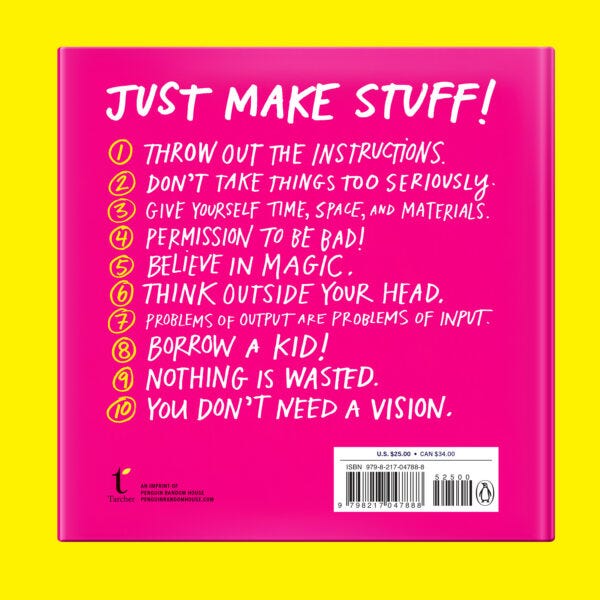
Austin described the book as being for anyone who’s lost that lovin’ feeling: you’ve been doing the work a long time, maybe even successfully, and the joy has quietly left the building. Where Keep Going was about pushing through a world gone mad, this one is Keep Going 2.0: the call is coming from inside the house. The chaos isn’t out there. It’s in here, with the deadlines and the invoices and the creeping suspicion that your passion has become your landlord.
I know this feeling intimately. Twenty-one years as a full-time cartoonist, and people still say “you’re so lucky, you get to do what you love every day,” and I want to grab them by the lapels and explain that they have no idea how hard it is to stay in love with a thing that is actively driving you insane. It’s not drudgery exactly. It’s more like the fruit has started to turn, and instead of leaping out of bed to bite the apple you’re standing in the kitchen at 7am wondering if you can make some sort of bread out of it.

Charlie Bucket’s Midlife Crisis
Which brings me to my Willy Wonka theory. End of the film. Great Glass Elevator. Wonka looks down at Charlie and says, “Don’t forget what happened to the man who suddenly got everything he ever wanted.” Charlie asks what. And Wonka says he lived happily ever after, but what he should say is:
He had to run a chocolate factory. Payroll for the Oompa Loompas. Health and safety inspections. Wait until they unionise next summer. I think about Charlie Bucket’s midlife crisis constantly. Charlie at 45, staring out over the Fizzy Lifting Drinks Room, thinking I thought I wanted this.
Austin, it turns out, came at the same territory through Jungian theory, because he’s classier than I am. He’d been reading James Hollis, and the Jungians treat midlife as a time of return: you’ve spent decades building the armour and the castle, becoming who you are in the world, and then the question arrives like a bailiff.
“Who were you before you built all this?”
His favourite version of the question, the one he asks everyone in his typewriter interviews: what did you do as a child that made the hours pass like minutes? People deflect with jokes at first. But push past that, and it’s always there. Drawing. Reading. Music. The thing that originally activated you. It’s still in you. You just have to reconnect with it.
So Austin is picking up dropped threads. Music consumed him as a teenager, so now he’s in a dad band that practises every weekend and has performed exactly one show, with a second looming. And he rides his bike, which produced the single best line of the night, the one I’ll be chewing on for months:
“I don’t ride my bike to feel the way I felt when I was ten. I ride my bike to feel the way I wanted to feel when I was ten.”
He grew up on a country road outside Circleville, Ohio, in the middle of what he describes as half cornfield, half bean field, depending on the year. He had the bike. There was nowhere to ride it. Time, space and materials, the equation at the heart of the book: you need all three, and if your creative life is broken, one of them is missing. He had the materials. He didn’t have the space. Forty years later, he’s reclaiming the ride he never got.
That’s the real engine of the book, and it’s why it isn’t a parenting book or a kids’ book, despite everyone begging him to write one. The breakthrough came from a Fiona Apple interview. She mentioned she reads parenting books. The interviewer, baffled, asked if she has kids or wants them. No, she said, but if she’s struggling with something, parenting books are just solid advice for humans. The interviewer said, “So you’re the parent and the child.” And Fiona Apple replied:
“Don’t you always have to be?”
Austin said a big Charlie Brown thought-balloon shot up out of his head. That’s the book. When you get older, you have to show yourself the care of a loving parent, so the wild creative kid in you feels safe enough to come out and let it rip. Not all the time. Just every once in a while.
(We then spent several minutes agreeing that Fetch the Bolt Cutters is THE pandemic album, dogs barking and all, and Austin shared that when he told his son she recorded some of it in GarageBand, the kid replied, “No wonder her name’s Apple. On brand.” Children are a bottomless font of one-liners, and they don’t even invoice you.)
One for Them, One for Me
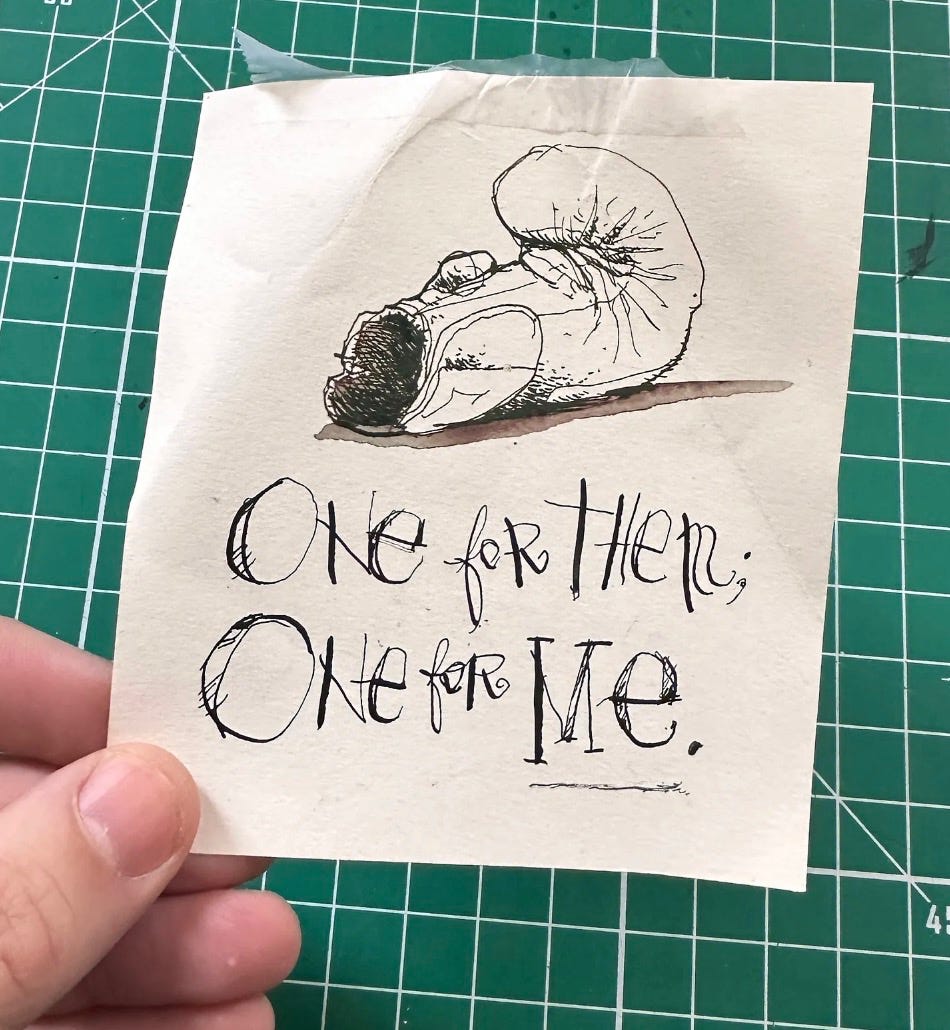
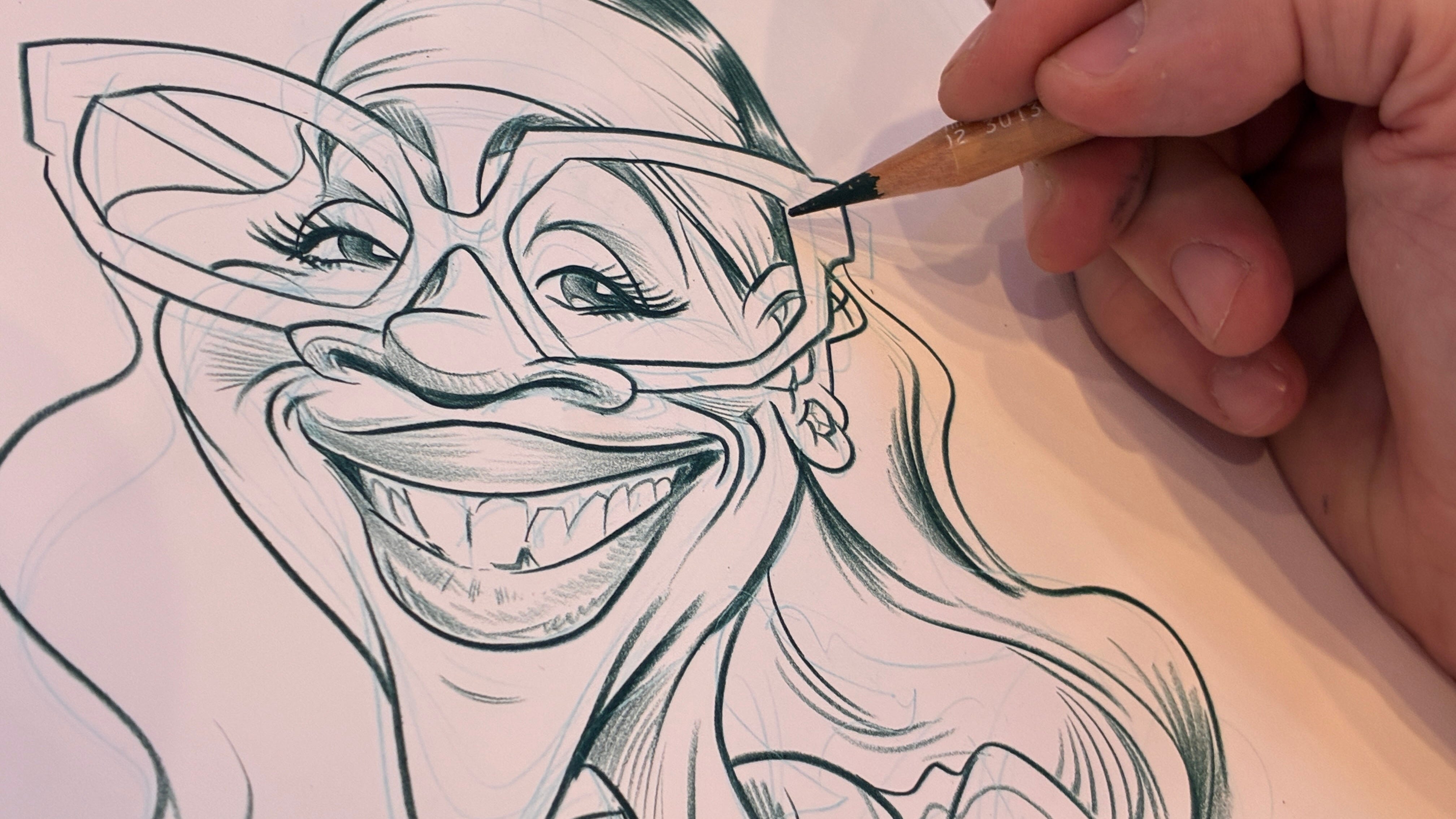
We talked craft, too. I told him about my caricature rule from live-drawing gigs: I do the kind version for the punter, then go home and draw the version I actually wanted to make. One for them, one for me. If the drawing you sold isn’t the drawing you needed, you owe yourself the second one.
Austin does the same with his kids’ artwork, photographing it at the exact moment before they add the evil villain who ruins everything. Every parent of a small artist knows that moment. The piece is finished. The child does not agree.
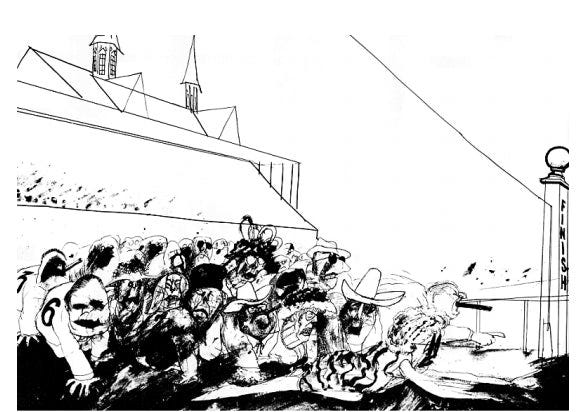
This led us to Ralph Steadman, via Hunter S. Thompson’s Kentucky Derby piece, which Austin had just re-read and which is secretly a story about Thompson begging Steadman to stop showing his grotesque drawings to the people he’d drawn, lest they both get punched in the teeth. The eternal question of that partnership: who was the real wild man? Steadman, we agreed, is an introverted wild man, the best kind, flicking ink at a blank page in his shed, ukulele within reach. Do you ever see someone and think, that’s what I want to be when I grow up? For both of us it’s Steadman. And Quentin Blake. And Hockney. And Barry Blitt, who, as Austin put it, is lit.

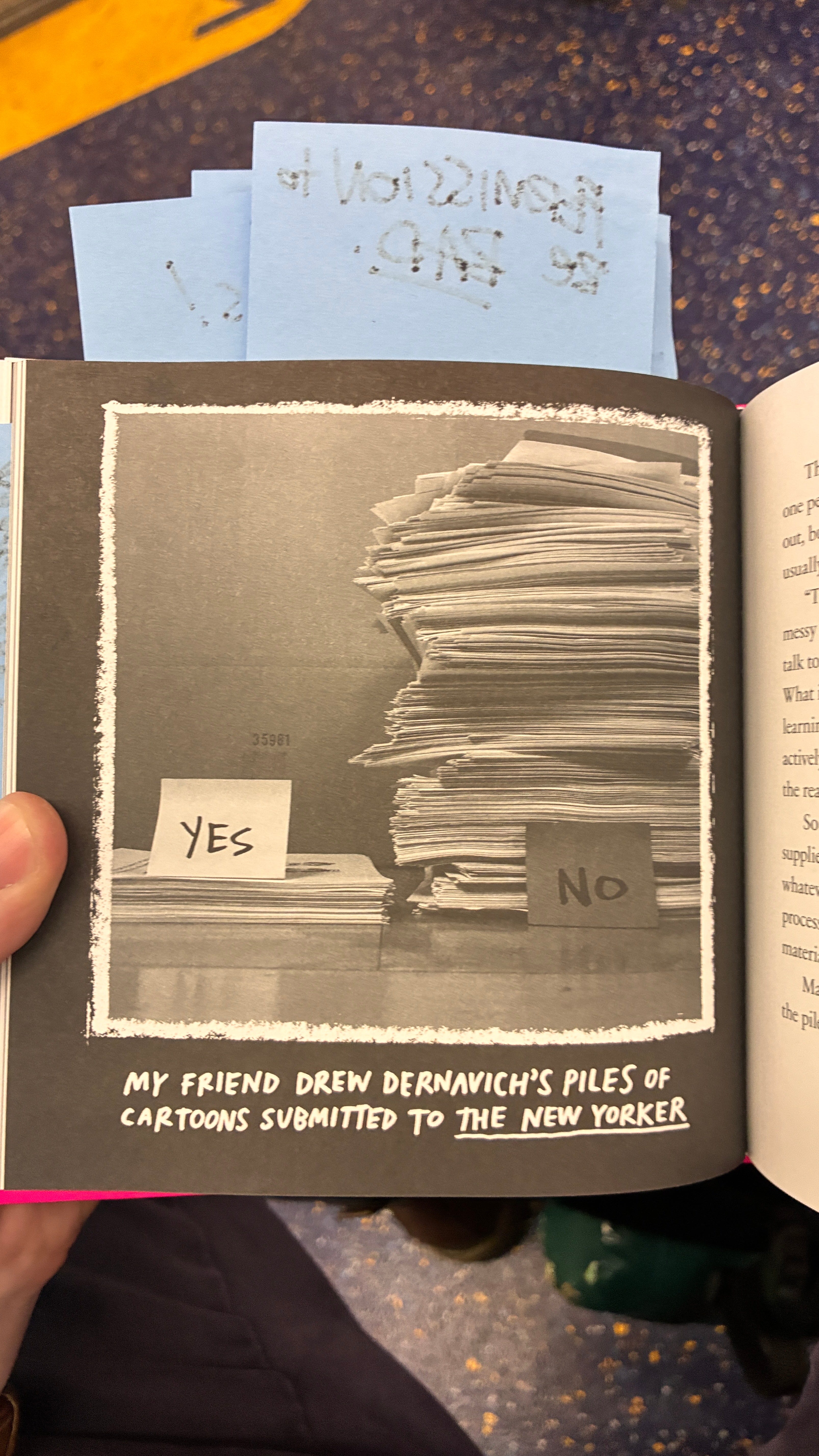
I also discussed this week’s published New Yorker cartoon (the Knicks one, this week) perched on top of roughly 4,000 pencil roughs nobody will ever see. Austin called it my personal rejection collection. Behind every yes is a thousand no’s, and nobody sees the no’s. There’s a whole chapter in his book called Make a Pile of Imperfect Things, which I intend to use as a legal defence for the state of my studio.
Pilgrimage Season
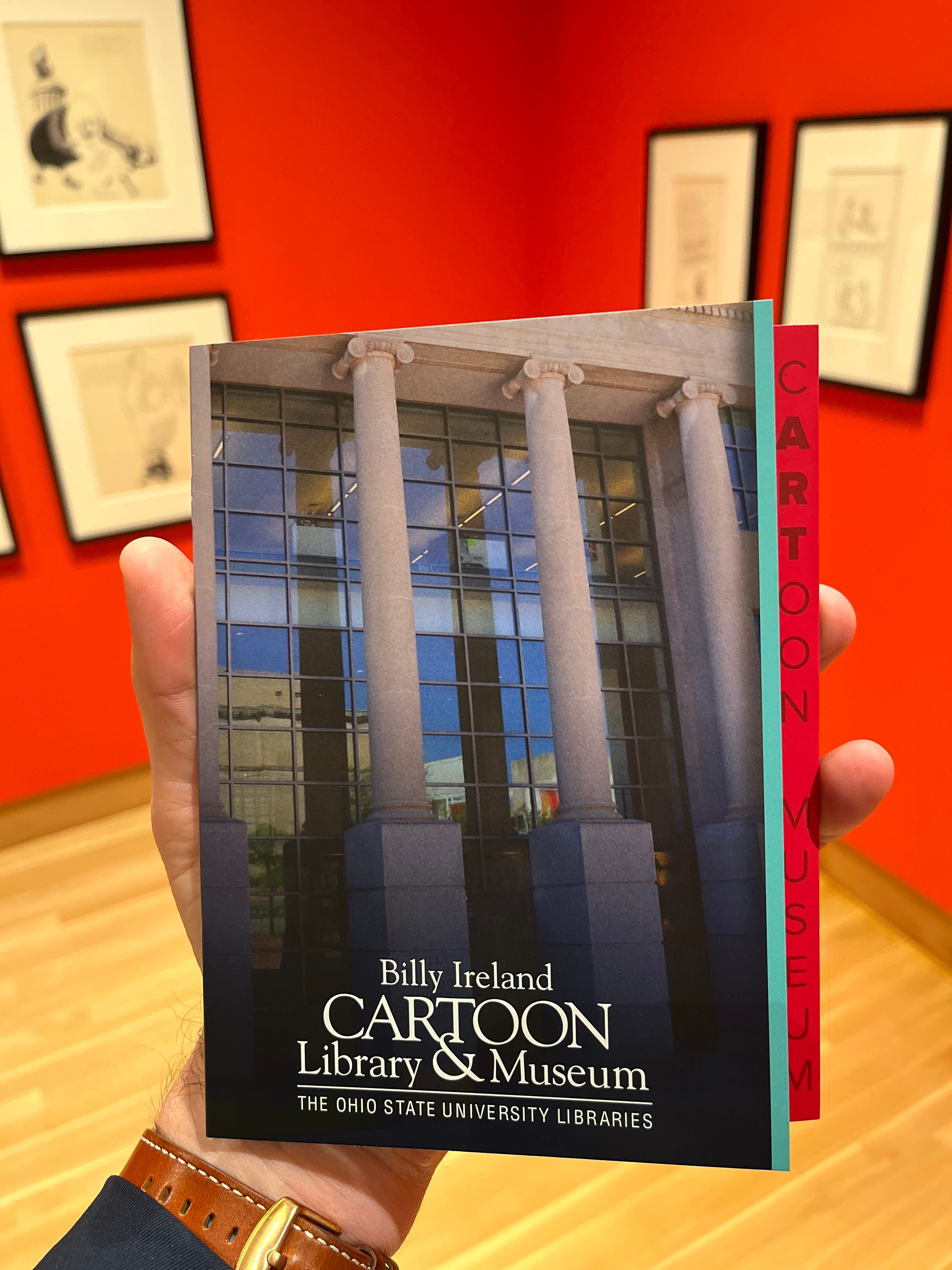
Final order of business: Columbus, Ohio. If you can get to the Billy Ireland Cartoon Library & Museum, the Chris Ware exhibition is one of the best things Austin has ever seen, and he grew up 40 minutes from the place. One side of the floor teaches you how comics work; the other side is a man who devoured the entire history of the form and rebuilt it inside his beautiful neurodiverse noggin.
The Billy is Disneyland for cartoonists, genuinely my favourite place in America, and I’ll be there twice in August: once for the National Cartoonists Society’s 80th anniversary and the Reuben Awards, and again for the Columbus Comedy Festival. Austin asked how you get an invite to the NCS thing. You don’t. You just come. (He’s coming.)
He’s also going to email the Billy and see if they’ll do a Substack Live walking tour. Watch this space.
Look. That’s the broad strokes, but the full replay has so much more: Me scribbling live, the chat going feral, the Russell Brand digression I have wisely omitted from this recap, and the moment a man blanked on the name of an author whose book was directly behind his head (It was Paul Jarvis!). Upgrade to paid, and you can watch the whole hour, plus the full archive of every Draw Me Anything so far.
Buy Don’t Call It Art if you want it. If you don’t, don’t. Don’t call it art. But do subscribe to Austin’s newsletter, which is easily one of my favourite things on the internet, written by one of the most generous people in it.
‘til next time!
Your pal,

PS. Look, if this actually did something for your brain (or at least distracted you from the creeping dread of your own inbox for six minutes), please consider restacking this and sharing it with your people. It’s the only way the word spreads.