Let me tell you who Myq Kaplan is, because if you’re not already a fan, that changes today.
He’s been doing comedy for going on twenty-five years. He has a Comedy Central special. He was a finalist on Last Comic Standing. He’s been on Comedy Bang Bang and Keith and the Girl more times than I can count. He has two specials on YouTube - AKA and Rini - and a new one he’s just recorded. He runs a Substack called Myq Kaplan's Arty Har-Hars, which you should subscribe to immediately after this. He is one of the most densely packed laughs-per-minute comedians working anywhere in this city, and I say that as someone who has been watching this scene very closely for fifteen years.
He is also the reason I once shot IPA out of my nose at a comedy show on Second Avenue. But we’ll get to that.

The first thing you need to know about Myq Kaplan is that his name is, by design, a barrier to entry. It’s pronounced “Mike”, not “Meek”.
“I brought it upon myself, obviously, the spelling of my name,” he told me, almost immediately after we started recording. “There’s a little bit of a barrier to entry. But once you get past, then I feel like there’s a lot of reward.”
He then, in the same breath, held up a microphone. “This is a Meek.”
I say “by design” because everything about Myq’s comedy is by design -the spelling of his name, the precision of his phrasing, the way a simple prop becomes the punchline to a joke that is also, if you look at it properly, a philosophical position about the rewards of paying attention. Nothing is accidental. The commitment to craft runs so deep that it’s become invisible, which is when craft becomes art.
The name story is one I’ve been dining out on since 2014. I was a young, fledgling comedian appearing on a certain popular podcast, and I was doing my plugs at the end of the show. Bob Kelly was hosting. I was reading names off the lineup for an upcoming show - I think it was the Producers Club - and I arrived at Myq’s name, and I said: “and Meek Kaplan.”
The room turned on me. Louis J. Gomez. Dan Soder. Joe List. All of them glaring at me with the familiar expression that New York comics reserve for someone who’s just revealed a catastrophic gap in their knowledge.
“You fucking Australians,” somebody said. “How have you never heard of Myq Kaplan?” They laid into me for twenty minutes. About my accent. About my ignorance. About the basic expectation that someone doing comedy in New York should know who Myq Kaplan is, which is, I’ll grant them, a fair point.
And then, having absorbed all of this - having been fully educated and corrected and aware - I subsequently introduced Myq on stage that night as “Meek Kaplan.” Again.
Myq received this with extraordinary grace. “Your trauma is my treasure,” he said.
But the real first time I encountered Myq Kaplan was not that night. It was earlier - 2011, or thereabouts. I was still coming to New York as a tourist then, once a year, for a month at a time, in the way that people who are going to end up living somewhere do before they commit to actually living there. I was going to as many comedy shows as I could, trying to understand the scene, sheepishly introducing myself to people and then overthinking every conversation afterwards on the subway home.
The show was called Kabin. It was on Second Avenue, the back room of a bar. Rebecca Trent booked it. It was, by the general consensus of everyone who was there at the time, the best comic hang in the city. Their fifth anniversary show, I think it was, went from six in the afternoon until five in the morning. 11 hours. I was in that room for most of it.
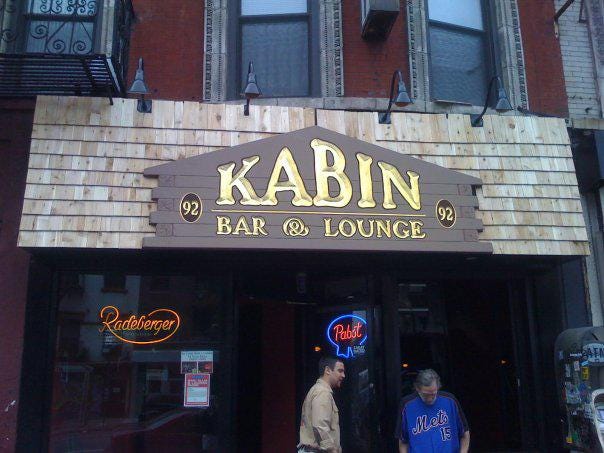
I had a beer in my hand. Sean Donnelly was hosting, or someone like Sean Donnelly. Whoever it was said, with the full weight of insider authority: you are going to love this next guy.
I took a sip.
Myq Kaplan walked on stage and said something. I genuinely do not know what it was. I have never known. What I know is that the beer - an IPA, specifically, which made the whole thing considerably worse - travelled at velocity through my nasal cavity and exited my face in a direction that beer is not supposed to exit. My eyes were streaming from the carbonation. I was making sounds that grown adults should not make in public. Eight minutes later, Myq left the stage, and I was a different person.
It is a trauma-memory. The kind that’s vivid, not because it was bad, but because it was so involuntary. The laugh didn’t ask my permission.

“That’s very, very kind, very thoughtful for you to share,” Myq said when I told him this story on the podcast. “Better than a spit take. Your trauma is my treasure.”

If you enjoy my work and would like to support, please upgrade to become a paid subscriber (only $1 per week)
Myq started comedy properly in 2002, coming up in Boston alongside people like Joe List. He counts 2002 as the beginning, though he first walked into a comedy club in 1999 - a senior in college, twenty-one years old, and there as a musician rather than a comedian, doing bits between songs. His parents were music teachers. He started the violin at four, took up guitar as a teenager, and began writing songs that were, as he put it, “supposed to be funny.” These he brought to the Comedy Studio in Boston.
They booked him for single-digit minute spots over the following three years.
In 2008, he went full-time. In 2010, Last Comic Standing gave him the biggest exposure bump of his career to date. By 2019, he’d recorded AKA, his previous special. And then he began building what would become Rini.
Rini is named after Myq’s partner - Rini being short for Catherine, spelt with a K. The special was originally going to be called Imperfect, styled with a capital P, so that it also read as I’m Perfect. The concept: a man moving from imperfect towards, theoretically, his own perfection. It’s a pun that’s also a philosophical arc, which is very Myq.
Over the years of building it, Rini - the person - became the show.
“A hundred per cent, it’s a love letter,” Myq said. “I say in the show that we have written, you know, to each other, with each other, about each other.”
Myq describes her contributions to his comedy with a gratitude that goes beyond the personal. She has a relationship with logic, with things making sense, with justice and meticulousness, that became, when applied to his material, transformative.
She would watch his show every night in Edinburgh. Take notes. They’d review them the next morning. Initially, Myq’s instinct was to resist. He had jokes that worked. Why take apart something that was working? The risk of losing the magic.
And then Rini said the thing that changed his approach: what if the joke could work and make sense? Wouldn’t that be better? “Logical and funny, logical and funny,” Myq said. “Or laugh for short, L-A-F. That’s just what my brain does naturally. And if I start aiming that...”
The new special he’s just recorded is the latest iteration of this process - Myq with a fully evolved approach, a year of psilocybin experiments behind him, a new structural framework (the alphabet, more on this shortly), and roughly a quarter century of craft underneath it all. He recorded Rini in partnership. He recorded Greene afterwards.

If I had to identify the quality that’s kept me coming back to Myq’s comedy for fifteen years, it’s the word economy. Nothing is wasted. The mechanics of each joke are as tight as a watch movement, and watching him think through the mechanism in real time is one of the genuine pleasures of this conversation.
He invented a word: abwordity. Absurd rhymes with words. So why not put word where absurd is? It’s absurd. “That would be like people’s impression of me,” he said, describing his early work - the jokes that were pure wordplay, pure structural delight, before he started asking himself what he actually wanted to say.
He brought up Eminem, of all people, and it’s the best analogy I’ve heard for this. Some of Eminem’s finest lyrics are about completely trivial things - the technique on display is staggering regardless of the subject. “You don’t have to tell people you’re the best rapper to have them know that you’re the best rapper,” Myq said. “If you just be the best rapper rapping about anything, then you’re the best rapper.”
The application to comedy is precise. The topic is almost beside the point. The craft is the point. Except -and this is where Myq gets interesting- he no longer believes the topic is beside the point. He’s built towards having both.
He has a line in Rini that I keep returning to, and I want to reproduce it exactly because the precision is the joke:
“I tell jokes, and I tell truths, and truths are just jokes that people don’t laugh at.”
After one show, a woman came up to him and said this had helped her relax and enjoy the rest of the performance differently. Myq received this gratefully. And then, internally: what was she doing before? Sitting there categorising everything? “Jokes and truths, jokes and truths, and not laughing at things because they were truths?” The observation works on two levels at once. As his comedy tends to.
“Every great work of art, every great piece of literature teaches you how to engage with it,” he said later. “Ideally, there’s nothing else like it. There’s very little like Moby Dick. There’s very little like Maria Bamford or Reggie Watts.”
And then the kiwi: no amount of description will tell you what a kiwi tastes like if you’ve never had one. You can get close. You can say it’s a fruit. But you have to taste it. Some comedy works the same way.

There is a George Carlin quote that both Myq and I have essentially archived in our personal database of Things People Get Halfway Right. The first part:
“It’s the comedian’s job to find the line, cross it deliberately, and... “
…and there it ends, in most quotations. Myq described this with barely contained irritation. “The comedian’s job,” he said, paraphrasing Carlin, “is to cross the line, find out where the line is, cross it deliberately…
…and bring the audience with you, and make them glad that you did.”
That’s the second part that nobody says. The second part is the whole argument. Without it, the first part is just a licence for chaos.
Myq was, in the beginning, in the mode most comedians start in: my intention is to bring joy; therefore, the joke is fine. He was also, looking back, wrong - or at least, incomplete.
He talked about going back and listening to his first album, recorded in 2009. There are jokes on it that he still loves. And there are jokes he wouldn’t tell the same way now -not because they’re bad, but because they’re jokes about weighty subjects that he hadn’t yet developed the understanding to treat properly.
“I’m glad that there are jokes that I wouldn’t tell now, because that means that I have grown.”
Todd Glass said it best:
“You can say whatever you want, but what do you want to say?”
Myq started from a place of precious jokes -holding them close, refusing to examine them. Terrified that taking them apart would break whatever magic was making them work. And then someone (in his case, Rini, with her highlighter) said: What if the magic could survive the examination?
It takes everyone a while. The people who figure it out tend to make better comedy.
Myq has read Finite and Infinite Games by James Carse, and he recommends it with the enthusiasm of a man who cannot stop applying it to everything. The concept: a finite game has rules and an ending - someone wins, loses, or it concludes. An infinite game has no ending. The point of an infinite game is to keep playing. Throwing a frisbee. The winning is the playing.
He makes the case that many things we treat as finite games are, at their best, infinite ones. Comedy, obviously - the craft never ends, the learning never concludes, the game goes on as long as you keep playing. But also: relationships.
“The relationship escalator,” he said. “You start dating, you’re going steady, you maybe move in, maybe you get engaged, then you get married. And it seems like a wedding is the end of the finite game of dating. Which, in some sense, maybe it is.”
But the wedding is just a point. The relationship is the infinite game. He and Rini have been together since 2016. They’re not married. He says this as someone who has concluded that the game continues regardless -the ongoing choice, the continuing construction of something without an end condition.
Colin Quinn said something once, at a keynote at the Montreal Just for Laughs festival, that Myq quoted:
“Once you’ve been doing comedy for five years, just know you don’t really know what you’re doing until ten. And for comedians who’ve been doing it ten years... It’s actually fifteen.”

“As long as it’s an infinite game,” Myq said. “As long as you want to keep playing it, you can keep playing.” He has been playing for twenty-five years. He does not appear to be close to stopping.
Then there’s Mario.
![Longplay] NES - Super Mario Bros: Two Players Hack [Hack, 2 Players, 100%] (4K, 60FPS) - YouTube](https://substackcdn.com/image/fetch/$s_!G0zf!,f_auto,q_auto:good,fl_progressive:steep/https%3A%2F%2Fsubstack-post-media.s3.amazonaws.com%2Fpublic%2Fimages%2F85712d0a-dbd8-4186-9423-9c3c12b5427c_640x480.jpeg "Longplay] NES - Super Mario Bros: Two Players Hack [Hack, 2 Players, 100%] (4K, 60FPS) - YouTube")
My sister found the warp zone. You know the one -at the start of a level, you jump in a specific spot, skip the whole game, emerge at the very end, rescue the princess, fireworks, music, done. The very first thing I wanted to do, the moment the credits rolled, was go back and play my favourite levels.
Thich Nhat Hanh, he says - and he delivers it with the timing of a punchline, which is exactly right: There is no way to happiness. Happiness is the way.
Become implies a destination. Be implies a practice. The whole game is there, in the verb.
He and his best friend Zach Sherwin -a comedian and rapper you should look up immediately- have developed a concept together around the New Yorker cartoon of the person climbing the mountain to ask the wise person at the summit the answers to life. (Myq mentioned his favourite: Bob Eckstein’s Rubik’s Cube cartoon…

Their conclusion: the wise person at the top of the mountain is your future self.
“I don’t know what’s going to be happening on June 5th,” Myq said. “Well, the me of June 6th is the wise person to ask that question to. He knows exactly what happened on June 5th, if he remembers.”
This landed as both a joke and one of the more practically useful things I’ve heard in years.
This brought us to Buddhism, which brought us to the second arrow.
The second arrow is a teaching that Myq encountered through Joseph Goldstein, one of his (and my) favourite Buddhist teachers. The first arrow is the thing that happens to you - the pain, the loss, the difficulty, unavoidable to varying degrees. The second arrow is what you do to yourself about the first arrow. The suffering you layer on top of the pain. The story you tell yourself. The resistance you mount.

“Pain is mandatory, suffering is optional,” Myq said, attributing this to the Buddhist framing around the second arrow. “Life is full of second, third, fourth - up to an infinite game of infinite arrows,” Myq said.
He also wrote a song about this, which he delivered in its entirety: “Pain means you’re alive, death means you’re not in pain. So the only thing to fear is hell, but hell’s not real, so we’re all set. And now we can just start murdering.”
He noted this was the whole song. Buddhists may hold their letters.

I want to be careful here, because Myq was careful here…
He has been doing ayahuasca for approximately twelve years. I experimented with psilocybin from 2023 through 2025, specifically in relation to how it affected my perception, writing, and comedy. Myq has been building, alongside all of his experimentation, a serious relationship with meditation and Buddhist teaching.
He went through what he calls, with genuine affection for his past self and equal affection for the absurdity of the phrase, “a missionary for mushrooms” phase. “I was like, oh wow, they’ve provided me such value,” he said. And then, gradually: “different people have different life experiences, different people have different brain chemistries.”
He made an argument I found genuinely interesting: “Any substance alters the mind. Like hunger is a state of mind. That is altered by eating food. Any food is literally a mind-altering substance.” He said this not to diminish what psychedelics are but to point out the continuity - consciousness is always being altered by something, and the questions are which alterations we choose, which teach us something, and which are available to whom.
His ayahuasca guide would say: “The effects come and the effects go.” While you’re in the throes of the experience, it might seem like it will never end. It will end. Every mental state you have ever been in, every thought you have ever had: none of them is happening right now.
This struck me as the most useful thing anyone has said about anything.
“My biggest struggle during a positive mushroom trip,” Myq said, “is often that I’m having such a meaningful, enjoyable, fulfilling, satisfying time that I’m like: ooh, I also want to remember some of these things for the future. And the conflict becomes: do I step out of the moment for a moment?”
The clouds come and go, as meditation puts it. You can never become happy. You can only be happy. The me of June 6th will know exactly what happened on June 5th.
And about where he is now, having been changed by all of it -by Rini, by the years of craft, by the Buddhism, by the psychedelics, by the endless chipping at the marble:
“I’m still “me”, you know, in the way that the conventional self, as the Buddhists would say, continues to exist. I am still me. But I am, I think, better. I am changed. I am kinder. I am trying to be. I’m working. I’m thinking about it more.”
And then we ran out of time.
The recording cut off before we were done…
I’m going to be honest: I’d completely lost track of time. We both had. We were somewhere in the middle of a thread about Lori Gottlieb’s Maybe You Should Talk to Someone -which Myq and Rini listened to on a road trip- and then the session simply ended. The app closed itself out. Myq and I were still talking.
I’m not sorry about it. You can plan a conversation, or you can have a conversation; with Myq, you have one, and it goes where it goes, and where it went was somewhere I didn’t expect, and I am still thinking about it.
That’s the thing about watching someone who has spent over two decades getting very good at something, and who has also spent the last decade thinking seriously about why they do it and how it connects to a life worth living. The conversation doesn’t feel like an interview. It feels like the kind of talk you have at two in the morning when the bar has emptied out, and neither of you is ready to go home yet.
I’ll have him back. We clearly didn’t finish.
Go to YouTube and search Myq Kaplan. Watch Rini first, on your laptop or your TV, with your full attention, phone face down. Watch AKA. Subscribe to his Substack. Go see him live in New York if you can.
The experience of Myq Kaplan in a room is categorically different from the experience of Myq Kaplan through a screen. I say this as someone who learned the hard way, through my nose, in 2011 at Kabin.
Some lessons stay with you.
‘til next time!
Your pal,

PS. Look, if this actually did something for your brain (or at least distracted you from the creeping dread of your own inbox for six minutes), please consider restacking this and sharing it with your people. It’s the only way the word spreads.