



Thank you Alex Hallatt, Margreet de Heer, eejits, chris eliopoulos, Doreen Schmid, and many others for tuning into my live video with Drive: The Sci-Fi Comic and Brad Guigar! Join me for my next live video in the app this coming Tuesday at noon - I’ll be talking to the recipient of the 2026 Thurber Prize for American Humour, Emily Flake! Put it in your calendars now.


Cartooning is, by its very nature, a deeply isolating profession. You spend the vast majority of your waking hours sealed in a room, hunched over a drawing board or a glowing Wacom tablet, having loud, animated arguments with people who only exist in your own head. There is no water cooler. There is no break room.
That is exactly why the Comic Lab podcast is so vital to the modern cartooning ecosystem, and exactly why I was so thrilled to have its hosts, Brad Guigar and Dave Kellett, on the stream today. Brad and Dave have recorded an astonishing 400 episodes of their podcast since 2018 (400 public episodes and hundreds more Patreon-exclusive pro-tips). They have essentially built a virtual bullpen for an industry that desperately needed one.
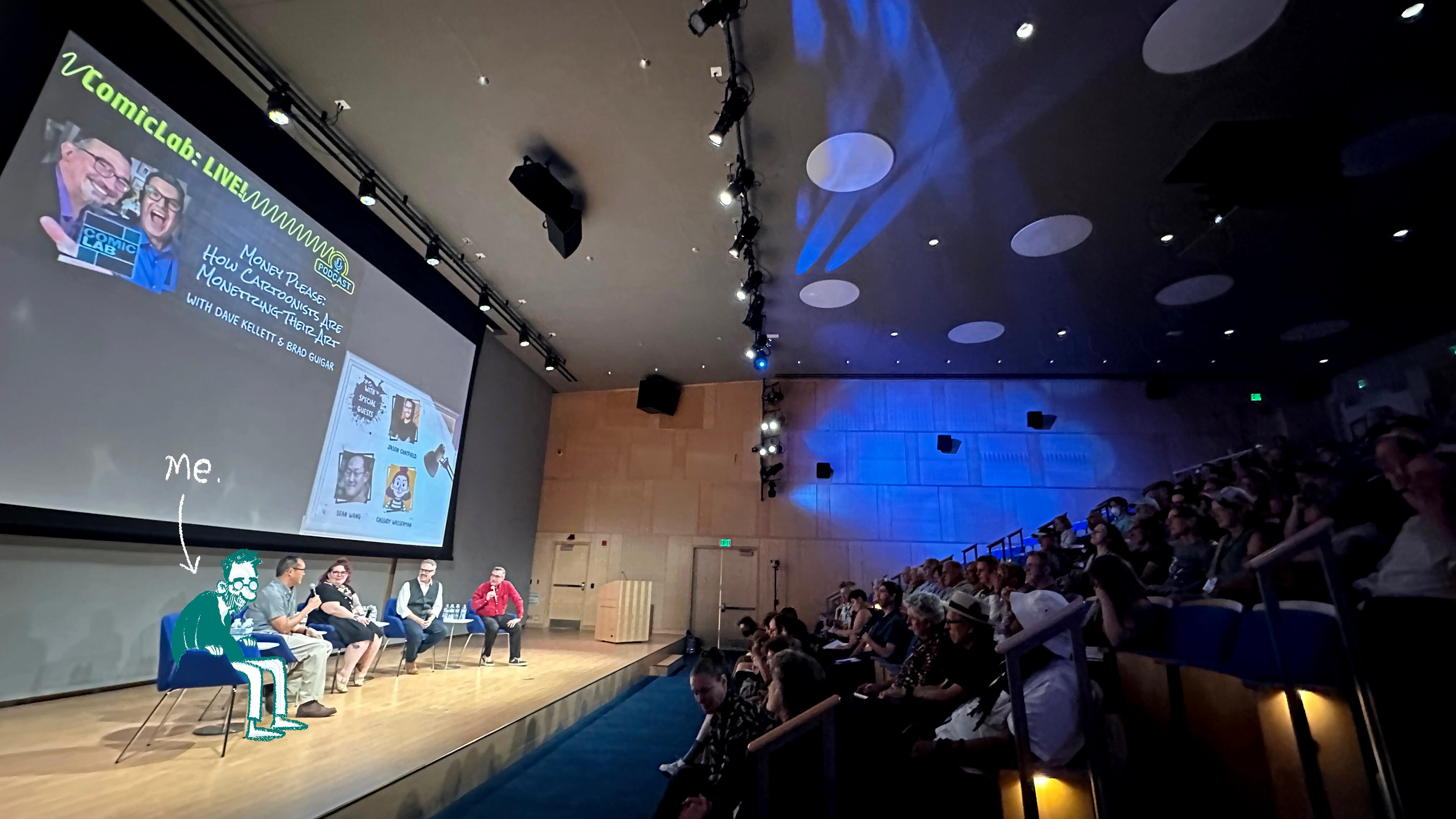
We talked about how Marvel Comics used to sell this fantasy of the “Marvel Bullpen” - a magical room where all the artists hung out, traded ideas, and cracked jokes. It was mostly a myth. But today, through podcasts and live streams, we are actually getting closer to a real, functional virtual bullpen.
We covered a ridiculous amount of ground in this episode, from the harsh realities of crowdfunding thieves to the fluid intelligence required to survive a 25-year career on the internet. Here is the breakdown.
Fluid, Crystallised, and Fossilised Intelligence
I recently read Arthur C. Brooks’ book From Strength to Strength, and I brought up a concept from it that perfectly encapsulates the trajectory of a long creative career. In the first half of your life, you are operating on “fluid intelligence.” Your brain is rapidly changing, you are building neural pathways, doing your 10,000 hours, and making your bones. In the second half, you transition to “crystallised intelligence.” You have the skills. You have made the mistakes. You have built the armour.
But Brad and Dave accurately pointed out the terrifying third stage that stalks older artists: calcification. Or, as Mike Rhode perfectly described it in the live chat, becoming “fossilised”.
If you enjoy my work and would like to support, please take out a premium subscription (just $1 per week)
We’ve all seen brilliant cartoonists whose careers came to a screeching halt in the early 2000s because they absolutely refused to adapt. They knew how they did things, the world changed around them, and they stubbornly refused to change with it. They insisted on remaining calcified in their old ways.
If you want the ultimate antidote to fossilisation, look no further than Mort Gerberg. I had dinner with Mort last Tuesday to celebrate his 95th birthday.

He is still submitting to The New Yorker, still writing gags, still busting chops, and still fiercely curious about the world. Mort literally wrote the bible for my generation of artists - Cartooning: The Art and the Business - a book that meticulously documented a bygone era of physically stomping around Manhattan with a portfolio tucked under your arm. He survives and thrives because he maintains a Norman Lear philosophy: you live as long as you can by working as long as you can.

The Innovator’s Dilemma and the NCS
We got into a fascinating discussion about the National Cartoonists Society (NCS) and its historically bumpy relationship with webcomics. For a long time, there was a deeply entrenched snobbery about online comics. The old guard viewed the industry as a zero-sum game. If a webcomic succeeded, they felt it was stealing column inches from a printed newspaper strip.
Dave offered a brilliant, highly empathetic reframing of this historical tension. He called it the “Innovator’s Dilemma”. (I know it was already called that but I hadn’t read too much about it until now so I’m calling it Dave’s. Okay!?)
He compared the old syndication model to the Ford Motor Company. Ford knows that Chinese electric vehicles are the future, but their entire factory platform, workforce, and supply chain are completely dependent on the internal combustion engine. If they pivot entirely to EVs, they actively cannibalise their existing income source. The old guard of syndicated cartoonists looked at webcomics - artists giving their work away for free on the internet - and were terrified. Adopting that model felt like active self-sabotage.
Thankfully, the NCS has evolved massively. They blew the doors open to webcomics, graphic novels, and online publications. The upcoming 80th anniversary Reuben Awards in Columbus, Ohio, is going to be a monumental celebration of the industry as it actually exists today. (If you have ever been on the fence about attending, this is absolutely the year to do it).
Related Reading:

Gary from Australia and the Crowdfunding Thieves
Making a living as an independent artist requires asking people for money, and anytime money changes hands on the internet, the scammers arrive in droves.
Brad and Dave are veterans of crowdfunding, and their advice was blunt: the moment you hit the “publish” button on a Kickstarter campaign, you must assume every single message you receive is a scam until proven otherwise.
They broke down the most common grifts targeting desperate, exhausted artists in the middle of a campaign slump:
The Big Bait: A scammer pledges $2,000 immediately, then emails you privately promising to increase it to $5,000 if you engage with them. They will inevitably pull the pledge at the last second, ruining your funding math.
The Fake Fixer: You receive an official-looking email claiming there is a critical error with your campaign, complete with a stolen Kickstarter logo. If you check the actual sender address, it is coming from a random Gmail account.
The Audience Broker: Agencies will demand $100 in exchange for bringing you 1,000 guaranteed backers. Brad correctly pointed out the absurdity here. There is absolutely no way a random marketing agency knows how to reach the Evil Inc audience better than the guy who’s been drawing Evil Inc for two decades.

“I ain’t that pretty!”
Dave has a fantastic internal mantra for dealing with suspiciously large, unprompted pledges: “I ain’t that pretty”. He knows exactly where he stands in the market. If someone drops $500 out of nowhere and asks for a favour, his cynical alarms immediately start ringing.
Brad, however, shared a hilarious and deeply painful story about falling victim to his own “Midwest niceness.” A backer named Gary pledged $250 to buy one of every book Brad had ever published. Brad quoted him for US domestic media mail shipping. The moment the campaign closed, Gary updated his shipping address to Australia. Instead of fighting it, Brad just ate the exorbitant international shipping costs and walked away with exactly ten dollars in profit. (Gary, if you are reading this, Brad has officially cancelled all international shipping because of you. Thanks a lot.)
The Substack Shift and the Algorithm Trap
We talked at length about why all three of us have heavily pivoted to newsletters and Substack. The reality of traditional social media is bleak. You’re constantly trying to game an ever-shifting algorithm just to reach the people who already asked to see your work.
Putting these streams together, wrangling brilliant guests, untangling the audio, and writing these detailed recaps requires a unique cocktail of intense caffeine and sheer willpower. If you value this virtual bullpen and want to access the full video replays, please consider upgrading to a paid subscription for just $1 a week. It repays the massive labour of writing these up, keeps the lights on, and keeps Morris supplied with the unnecessarily expensive treats he demands.


