



Thank you Samantha Dion Baker, À Chacun Son Goût by Tarik O., Jenifer Douglas, Art by Polly, Pat Coakley, and many others for tuning into my live video!
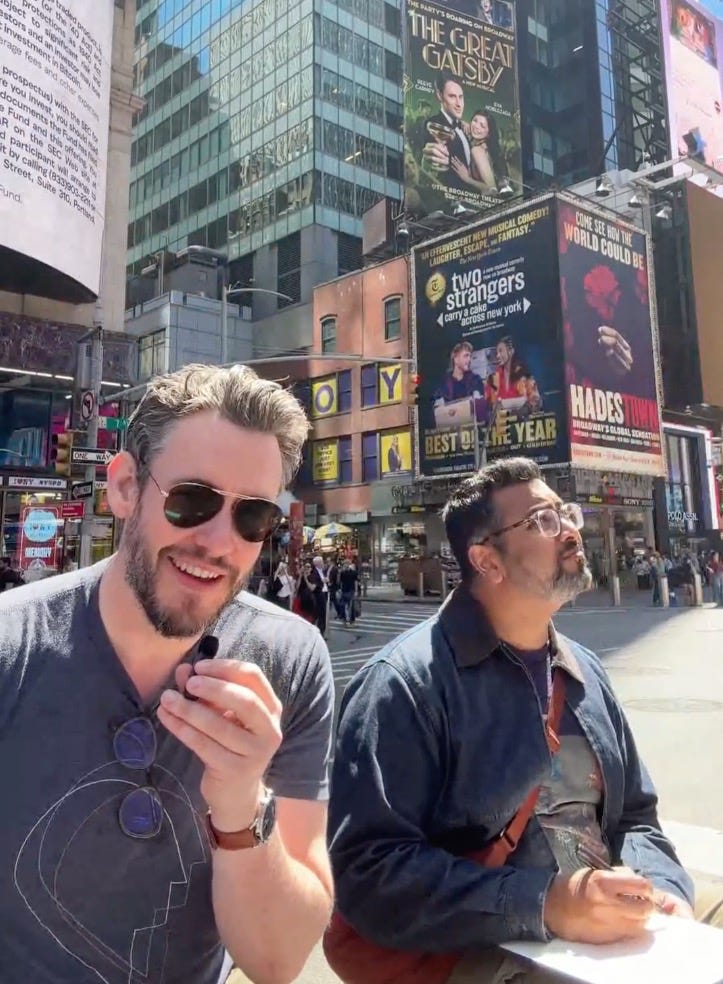
As usual, Nishant Jain and I could have talked for another four hours, and there is so much to cover here. Writing up this recap was really difficult because I could have gone for 20,000 words; I had to pare it down. So, I’m going to break it into four parts today…
As always, if you want to watch the full replay, please upgrade To Paid. I really appreciate your support.
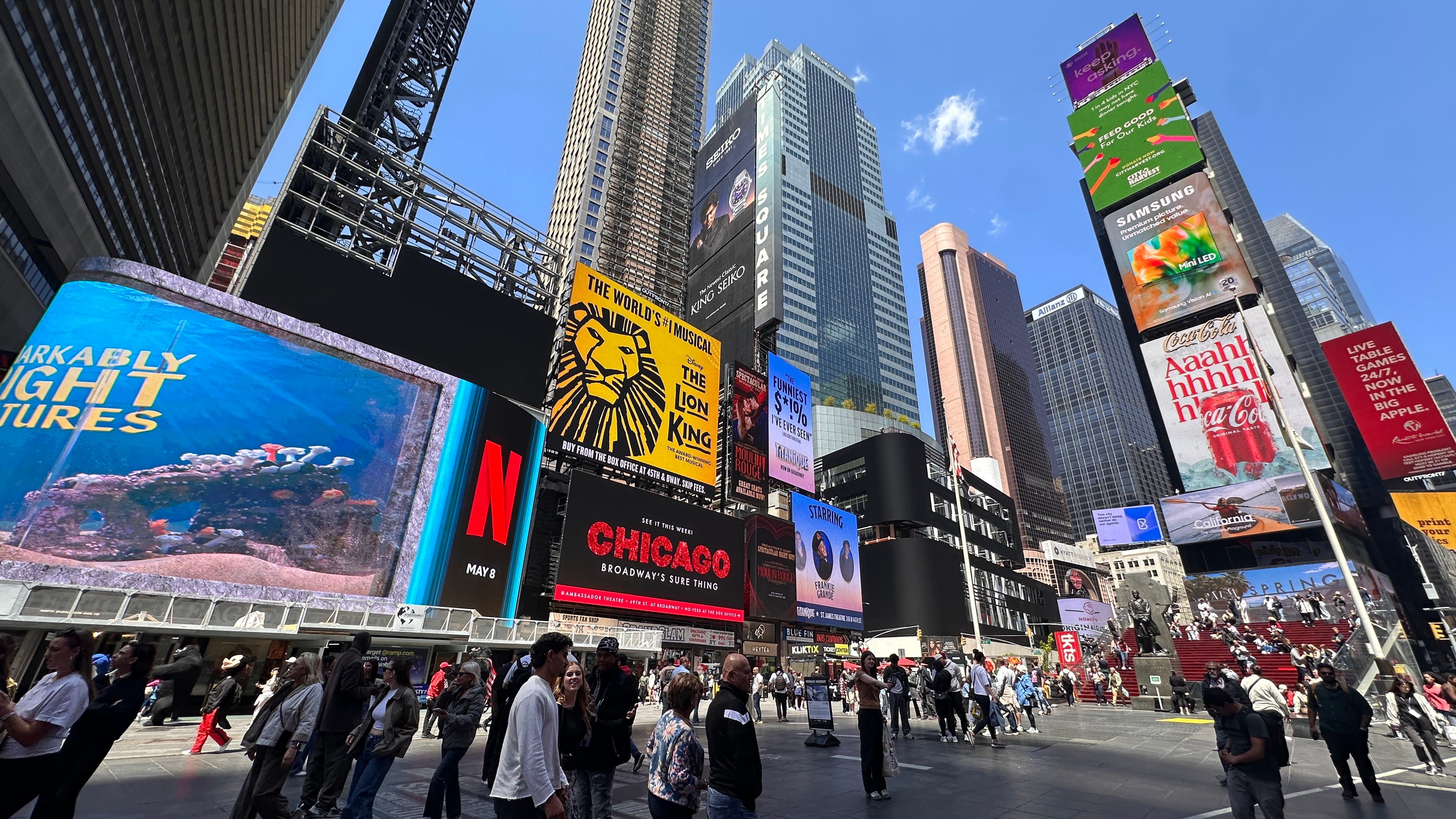
If you want to test the absolute limits of your nervous system, try sitting in the middle of Times Square with a sketchbook, a pen, and an open microphone...
It is a sensory assault. It does not smell like inspiration; it smells like roasted nuts, diesel exhaust, and the sweat of ten thousand tourists realising they’ve lost their Marriott room key. The noise is a physical weight. Sirens, pedicabs aggressively looping Alecia Keys, and people dressed as off-brand Spider-Man aggressively demanding five dollars for a photo.
“Drawing in New York is combat journalism. You’re trying to capture lightning in a bottle while the bottle is being kicked down Broadway by a guy screaming at his phone.”
But this is exactly why I do this. When I started New York Cartoons, the core promise to you, the reader, was that I wasn’t just going to send you polished, sterile drawings from the safety of an air-conditioned studio. The promise was to show you what living, surviving, and creating in New York City actually looks like. The chaos, the invisible labour, and the absurd encounters that fuel the work.
So, for this week’s episode of Draw Me Anything, I took the studio to the street!
My guest was the brilliant Nishant Jain, better known to his massive audience as The Sneaky Artist. Nishant came down from Canada to sit with me in the blistering epicentre of Manhattan. For an hour, amidst the absolute bedlam of Times Square, we drew the chaos in real-time.
Before the stream started, a tall man holding a brown paper bag whipped towards us before locking eyes with me… it was, of course, my neighbour and pal Anthony LeDonne. Because of course it was. (You can see his SYML entry here.) When I introduced him to Nishant, I’d mentioned we were nerding out about Derrida last time we spoke. When he asked who that was, I knew he’d be in for an education… Nishant gave him a primer on the arsehole French philosopher and his musings. I could see the hamster in Anthony’s brain begin to sweat, then die in a mad panic. Derrida: It’s one helluva conversation starter.
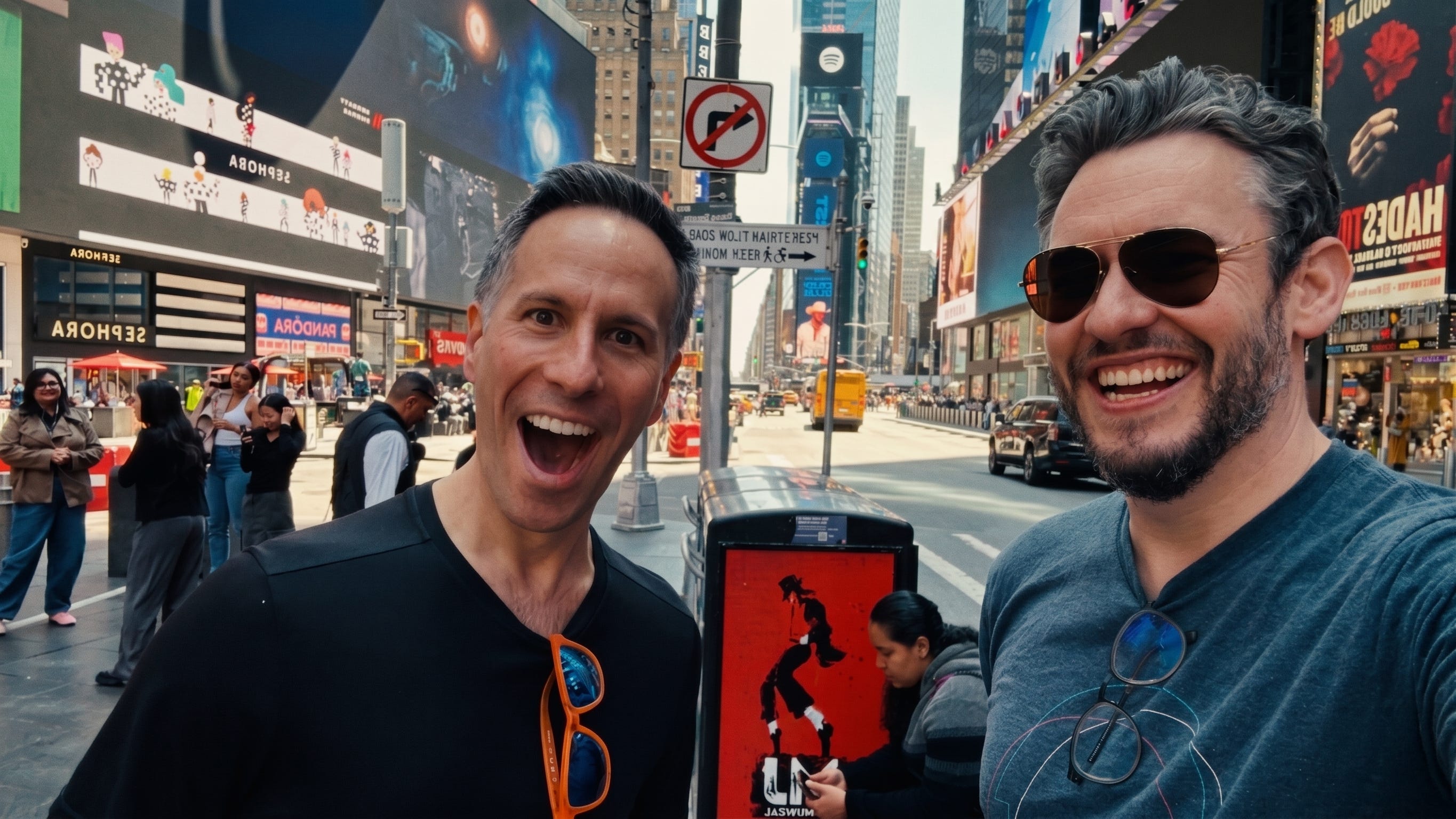
What started as a live drawing session quickly spiralled into one of the most profound, quotable, and vital conversations I’ve had in years. We talked about everything from French philosophy and the existential threat of tech companies to the mindfulness of observation and the stark contrast between Canadian politeness and New York velocity.
Here’s what happens when you put two process-junkies in the loudest intersection on Earth…
Part I: Vancouver VS. New York
There’s a distinct difference in the way a New Yorker observes the world versus the way a Canadian does, and watching Nishant work was a masterclass in pacing.
Nishant possesses a terrifying level of calm. He didn’t fight the chaos. He observed it. He mentioned how different the nature of New Yorkers VS Canadians is, and how he’s adapted from his roots:
“This has happened to me over the last two years, it's default for me every time, at least this is true for Vancouver. Every time a person from Vancouver gets off the bus, even if it's like one of those long buses, so they can't hear you, everyone says thank you to the bus driver. Everyone.”
Drawing in New York is combat journalism. You’re trying to capture lightning in a bottle while the bottle is being kicked down Broadway by a guy screaming at his phone.
But despite the velocity of the city, Nishant’s process is startlingly deliberate. As we talked, he casually built what would become a beautifully complex drawing of the scene. He wasn’t rushing. He was practising what he calls the radical act of paying attention.
"Be moved by this moment. The drawing in Times Square has to have the vibrations of Times Square. So you've got to move to the peaks of this place. The annoying music, the sirens, the power horns, they're all part of it."
Part II: The Mindfulness of the Pen, and the Radical Act of Paying Attention
We spend so much of our time talking about “mindfulness” as this sterile, corporate buzzword. (I’ve written about this before) Tech companies have commodified it. They sell us apps that ding to remind us to breathe, which we check on the same glowing rectangles that are actively destroying our attention spans.
Nishant’s approach to drawing is the exact antidote to this. For him, drawing isn’t about producing a piece of “content” for an algorithm. It is a grounding mechanism.
“Drawing isn’t about making a pretty picture,” Nishant said, his pen moving carefully across the paper.
“Like, you can pass through the world with your phone, and you can very easily take photos without paying attention. So you're not giving, paying attention literally, as in paying something, like you have to give time and have to look with your senses. So drawing is a call to do that and to be present to listen to the sounds"
That hit me like a freight train. In the digital mailstrom, we take thousands of photos we will never look at again. We consume the world in half-second swipes. But when you drag a pen across watercolour paper, you’re making a physical record of time spent. You are saying, I was here, and I paid attention.
"Your body and mind are absorbed in the union of an ask, which is to look to interpret and then to put it down, translate it, and in a lot of ways, you shut out a lot of concerns, you stop thinking about time, you stop thinking about your responsibilities of service, and you're just here for a while."

If you’re a free reader, now is the time to upgrade.
A subscription costs less than a bad bodega sandwich, and it directly funds the real, human, unapologetic art that the tech companies are actively trying to automate out of existence. Support the artists who are actually paying attention.
Please upgrade to become a paid subscriber (only $1 per week)

Part III: Derrida, Language, and the AI Plagiarism Machine
Naturally, sitting in the glowing neon Mecca of American capitalism, the conversation pivoted to the tech overlords and the looming shadow of Generative AI.
If you read my essays, you know my stance on the “AI Slop Machine.” I view it as a cultural parasite. But Nishant brought a deeply intellectual, philosophical lens to the conversation that completely reframed the issue for me. He brought up Jacques Derrida.
For those who skipped French Philosophy in college, Derrida was the father of “deconstruction.” He famously argued that language isn’t just a tool we use to describe reality; language creates the boundaries of our reality. We can only understand the world through the vocabulary we have to describe it.
"The point of AI is not to make articles; the point of AI is to make an endlessly spinning mill of content to feed their social media algorithms to hypnotise and make you into addicts so that you become a passive consumer instead of a creative"
He paused to add a shadow to the drawing of an awning.
“If Derrida is right -if language shapes our reality- then handing our visual and written language over to a machine is incredibly dangerous. How colonisation works right, you convince people that their work is worthless and then you steal it from them, and then you sell it back to them on a subscription, and you dehumanise craft and creativity until nothing is left.”
This is the exact problem with AI art. It looks perfect at first glance, but it contains absolutely zero humanity. It has no point of view. It doesn’t know what it feels like to sit on a cold metal chair in Times Square while a siren blares in your left ear.
"artistic inspiration and inspiration from the world is not just the ambit of the professional artist right this is an essential human job yeah this is part of being human."
Part IV: The Finished Masterpiece
By the end of the 50-minute conversation, my own drawings were a frantic, scratchy, high-energy reflection of the anxiety of Times Square. It looked like New York feels.
But then Nishant held up his sketchbook.
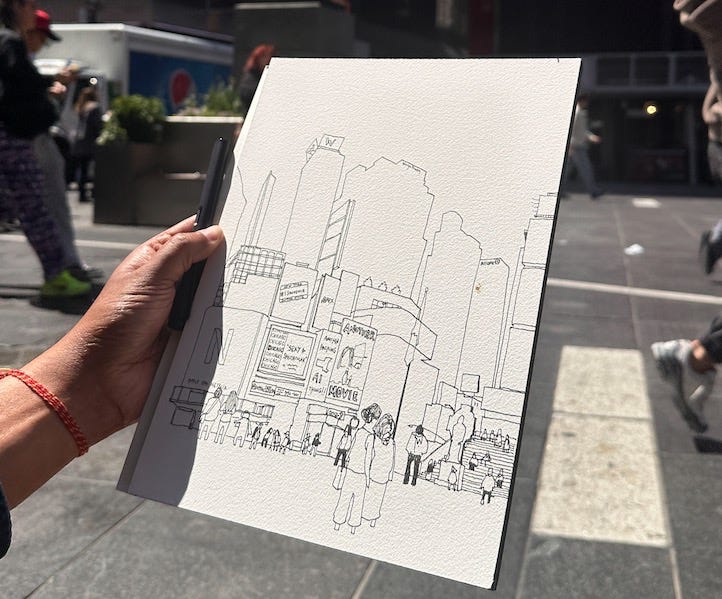
I actually stopped talking for a second. Look at that, I said on the stream. It was incredible. This guy had just casually, while dissecting French deconstructionism and the ethics of tech conglomerates, built the most insanely beautiful drawing of the intersection.
It wasn’t just a rendering of buildings and tourists. It had life in it. You could see the deliberate choices he made -what to include, more importantly, what to leave out, what to emphasise. It was the absolute antithesis of an AI-generated image. It was a physical artefact of a human being paying deep, mindful attention to a chaotic world.
Watch the Full Replay…
Reading these quotes and clips is only half the experience. If you want to actually see the process -if you want to hear the sirens, see the pen hit the paper in real-time, and watch two working artists navigate the muck of New York City while talking about the survival of human art, you need to watch the replay.
This is the promise of New York Cartoons. I don’t hide the process. I don’t put a filter on the reality of this job. The full, uncut, 50-minute video replay of our Times Square drawing session is available right now for paid subscribers.


